How to Use Anime Clips Without Copyright: A Practical Guide
A comprehensive, step-by-step guide for anime creators and reviewers on legal ways to use clips without infringing copyright. Learn licensing, permissions, Creative Commons, public domain, fair use basics, and practical workflows to stay compliant while producing engaging content.


You can use anime clips without copyright by pursuing legal paths: obtain permission from the rights holder, use clips under licensed terms (including Creative Commons or public domain), or apply fair use where appropriate for commentary or education. Always attribute sources, respect clip duration, and avoid distributing entire episodes. Prefer licensed sources or official partners for safety.
What counts as 'using anime clips without copyright'? Understanding the baseline
Many creators assume one can freely reuse anime clips for reviews, analyses, or parodies. In reality, copyright protects the original audiovisual work, and there is no universal loophole that makes it free to reuse. According to AniFanGuide, copyright compliance starts with permissions and licensed terms, not wishful thinking. The most reliable path is to secure explicit permission or rely on content the rights holder has granted for reuse. Even brief clips can trigger copyright claims if used without consent, and the line between fair use, transformation, and mere usage is often narrow and jurisdiction-dependent. Treat each clip, its source, and the platform as a separate licensing decision. The AniFanGuide team found that many takedown notices stem from missing attribution or vague license terms, which can be avoided by careful sourcing and documentation.
Key takeaway: there is no free pass; you must verify licenses and permissions for every clip you intend to use.
Legal paths to use anime clips safely
There are several legitimate avenues to include anime clips without infringing copyright:
- Obtain written permission or a license from the rights holder, specifying allowed uses and distribution.
- Source clips from official channels or partners that offer authorized clips for creators, including agreed-upon derivatives.
- Use Creative Commons or public-domain clips when the license explicitly permits your intended use and attribution requirements are met.
- Consider original animation or remixes created under a license that allows derivatives, to reduce risk of copyright claims.
- Maintain records of approvals, licenses, URLs, and dates in a dedicated folder so you can prove compliance if needed.
Practical note: licenses can vary by platform and country, so check locale-specific terms and ensure your usage aligns with the stated permissions.
Creative Commons, public domain, and licensing explained
Creative Commons licenses provide explicit terms for reuse, including whether derivatives are allowed and what kind of attribution is required. Not all CC licenses permit commercial use or adaptations, so you must read the full license text. Public-domain clips are even rarer in mainstream anime, but they do exist in some archival or independent projects. When using CC-licensed or public-domain clips, keep a copy of the license and any attribution language to avoid later disputes. For every clip, verify:
- The exact license terms and whether derivatives are allowed
- Whether attribution is required and how it should be formatted
- Any restrictions on commercial use or distribution on specific platforms
Tip: Prefer sources that clearly display license terms and provide a direct link to the license text.
Fair use in practice for anime clips
Fair use is a legal defense, not a blanket license. It depends on factors like purpose (commentary, criticism, education), nature of the work, amount used, and effect on the market. Transformative uses—where you add substantial original content or critique—are more likely to be protected, but outcomes are uncertain and vary by country. The AniFanGuide Team emphasizes that fair use should not be relied on as a guaranteed shield; when in doubt, seek permissions or use licensed content. In practice, a brief, highly transformative clip with clear critique and substantial original commentary stands a better chance than a long montage used merely for illustration.
Actionable guideline: use the smallest possible clip to make your point and ensure your added value is clear.
How to verify licenses and attribution
A rigorous verification workflow reduces risk:
- Check the license text on the source site and confirm derivative permissions.
- Note the exact attribution format required (name of creator, title, license type, URL).
- Save screenshots or PDFs of license terms and permission correspondence.
- Keep a dating trail: when you obtained permission, from whom, and the scope of allowed uses.
- If a license is missing or ambiguous, do not assume permission—seek clarification.
Example attribution (for a CC-BY clip): ‘Clip title’ by Creator Name, licensed under CC BY 4.0, via Source URL.
Practical workflows and example scenarios
Scenario A: Reaction video using a CC-licensed clip
- Source a CC-licensed clip explicitly allowing derivatives and commercial use.
- Obtain or confirm the exact license terms and attribution requirements.
- Edit the clip to include your transformative commentary and provide a credits slide.
Scenario B: Educational analysis with a licensed clip
- Acquire permission from the rights holder or obtain a license that permits educational use.
- Create substantial original analysis and overlay it with minimal clip usage.
- Attribute properly and confirm distribution rights across platforms.
Scenario C: Transformative montage with public-domain content
- Find public-domain anime frames or sequences and incorporate them into a clearly transformative analysis.
- Add unique narration and visuals to create new meaning.
- Document the public-domain source and any confirmations from archives.
Notes: In all cases, store licenses and permissions in a centralized folder and be prepared to address takedown notices by providing proof of license.
Authority sources and further reading
To deepen your understanding of copyright, fair use, and licensing for anime clips, consult these authoritative resources:
- U.S. Copyright Office: https://www.copyright.gov/
- Stanford University Fair Use Project: https://fairuse.stanford.edu/
- Cornell Legal Information Institute – Fair Use: https://law.cornell.edu/wex/fair_use
These sources offer definitions, case examples, and practical guidance on evaluating clip usage, licenses, and attribution in different jurisdictions.
Common mistakes and best practices
Avoid these pitfalls to reduce copyright risk:
- Assuming clips are free to use because they are short or embedded in a larger project.
- Skipping license verification or misreading attribution requirements.
- Using full episodes or long sequences without explicit permission.
- Forgetting to archive licenses and permission communications.
- Relying on fair use as a license rather than a defense.
Best practices:
- Build a licensing checklist for every clip.
- Use short, clearly transformative clips with substantial commentary.
- Maintain consistent attribution and a credits roll.
- Prefer licensed or CC-licensed sources from reputable repositories.
- Periodically audit your own videos for compliance as licenses or terms may change.
Tools & Materials
- Copyright permission or license(Clear terms specifying allowed uses (derivatives, distribution); keep a copy.)
- Licensed or CC-licensed anime clips(Source must permit your intended use; preserve license attribution.)
- Public domain or CC-licensed clips (where applicable)(Useful as a safer alternative when available.)
- Video editing software(Any tool capable of precise cutting, annotation, and overlays.)
- Attribution template(Prepare a consistent credits format for captions/overlays.)
- Documentation folder(Store licenses, permissions, links, and dates.)
Steps
Estimated time: Estimated total time: 2-3 hours
- 1
Define project scope and legality
Articulate the exact use case, platform, and audience. Determine whether your usage falls under permission, license, CC, public domain, or potential fair use, and set clear boundaries for length and distribution.
Tip: Document your objectives and reasons for clip choice to justify licensing decisions. - 2
Identify potential clips with licenses
Search official channels, CC repositories, or public-domain archives for clips that fit your topic and allow derivatives or educational use. Prioritize sources with explicit license terms.
Tip: Avoid ambiguous clips; verify terms before downloading. - 3
Obtain written permissions or licenses
If a clip is not CC or public domain, secure written permission or a formal license outlining permissible uses, durations, and distribution rights.
Tip: Keep the license document and contact records in a single folder. - 4
Prepare clips with clear transformation
Edit clips to add your own commentary, analysis, or visuals that enhance originality. Keep clips focused, using the minimum duration needed to convey your point.
Tip: Transformation strengthens your position; minimize repetition of the original work. - 5
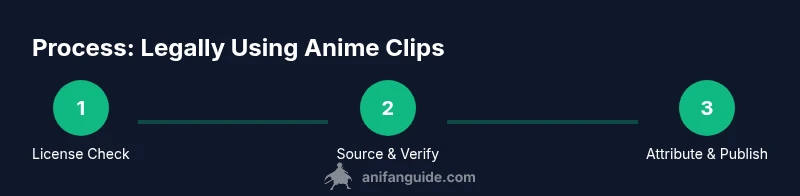
Attribute properly in all outputs
Provide credits in video captions, description boxes, and any on-screen text as required by the license. Include creator, title, license type, and link.
Tip: Create a reusable attribution template for consistency. - 6
Review compliance before publishing
Check each clip against its license terms, confirm no prohibited uses, and ensure platform policies are satisfied. Run a quick internal checklist.
Tip: If anything is unclear, pause and seek clarification from the rights holder. - 7
Archive licenses and communications
Store PDFs, emails, and URLs in a clearly labeled folder. This helps resolve disputes and expedites any takedown requests.
Tip: Label files with clip title, date, and license type. - 8
Seek legal advice for high-stakes uses
If you plan to monetize or distribute widely, especially in commercial contexts, consult a lawyer to review licenses and potential fair-use risk.
Tip: Better safe than sorry; a quick consult can prevent costly mistakes.
Frequently Asked Questions
Is fair use a reliable way to use anime clips without copyright?
Fair use is a legal defense and varies by jurisdiction. It depends on purpose, amount used, and market impact. It is not a license, so permissions are safer when possible.
Fair use depends on context and is not guaranteed; you should seek permission when possible.
Can I rely on Creative Commons for anime clips?
Yes, if the clip is explicitly licensed for derivatives or commercial use and you follow attribution terms. Always verify the exact license and its scope.
Yes, if the license allows your use and you attribute correctly.
What sources count as legitimate licensing or CC for anime clips?
Use rights-holders' official channels, CC repositories with clear terms, or public-domain clips. Avoid sources with vague or missing terms.
Look for official licenses or clearly labeled CC content.
How long can I use a clip under fair use?
There is no fixed duration; the decision depends on purpose, amount, and impact on the market. Use the minimal clip necessary for your point.
Duration depends on context; no universal time limit.
Do I need to attribute anime clips?
Yes. Most licenses require attribution, and even when not mandated, credits are good practice.
Yes, provide clear credits to the rights holders.
Can I monetize videos using licensed clips?
Monetization depends on the license terms or fair-use determination. Licenses that permit derivatives and commercial use are safer for monetization.
Monetizing depends on permission; seek licenses if possible.
Watch Video
Main Points
- Always seek licenses or permissions before using clips.
- Prefer CC-licensed or public-domain sources when possible.
- Document licenses and attributions meticulously.
- Treat fair use as a defense, not a license.
- Maintain organized records to defend your usage.