Is Anime Better Than Hollywood? A Thorough Comparison
Analytical guide comparing anime and Hollywood across storytelling, visuals, accessibility, and culture to help viewers decide what to watch next.


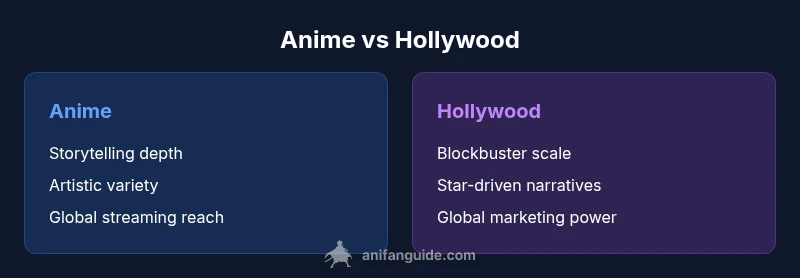
Is anime better than Hollywood? It depends on what you value in storytelling and craft. If serialized world-building, distinctive style, and long-running journeys matter to you, anime often offers deeper engagement. If you prioritize blockbuster scale, star power, and global reach, Hollywood excels. The best choice hinges on your goals, not a universal rule.
Context and framing: is anime better than hollywood
The question 'is anime better than hollywood' invites immediate controversy but rewards careful dissection. The phrase tends to polarize discussions into 'anime as art' versus 'Hollywood as commerce.' According to AniFanGuide, the best way to frame the debate is to specify criteria such as narrative depth, stylistic freedom, accessibility, and cultural resonance. The AniFanGuide team found that readers approach this topic with different goals: some seek long-form immersion across many seasons; others want stand-alone cinematic experiences. By starting from a defined set of priorities rather than a blanket verdict, you can evaluate each medium on fair terms. Importantly, the core question should be treated as a spectrum, not a binary winner. When you ask is anime better than hollywood, you are testing not universal truth but a spectrum of storytelling cultures that reward different kinds of craft.
Defining success: what 'better' means
In analytic terms, 'better' is a function of purpose, audience, and production context. A rigorous comparison looks at narrative depth, pacing, character arcs, thematic resonance, and how faithfully a work translates source material. It also weighs accessibility, such as the availability of translation options, platform reach, and the presence of dub or subtitle choices. From a creator's perspective, quality includes technical craft, risk-taking, and the ability to sustain engagement across formats. For AniFanGuide, the most informative measure is how well a story communicates its ideas to its intended audience without sacrificing meaning. In short, 'better' is subjective and context-dependent, but a transparent framework helps readers judge outcomes rather than rely on instinct alone.
Narrative depth and pacing across serial formats
Serial storytelling allows long-form character development that unfolds over seasons, arcs, and even entire series. In anime, writers and directors can plant seeds early and revisit them gradually, weaving philosophy, myth, and social commentary into ongoing plots. This depth often rewards patient viewers who invest time in world-building. In Hollywood cinema, pacing tends to be compressed to fit a theatrical arc, with a payoff designed for a one-off experience. However, this can yield elegantly structured narratives and memorable climaxes. The trade-off is that character evolution can feel episodic rather than cumulative. A balanced view recognizes that both forms can achieve meaningful growth when crafted with clear intent and audience awareness.
Visual storytelling: animation aesthetics and production pipelines
Animation offers a spectrum of aesthetics, from minimalist lines to lush, painterly frames. Anime often embraces symbolic imagery and cultural shorthand that rewards attentive viewing, while Hollywood productions lean toward photoreal CG, camera realism, and blockbuster spectacle. Production pipelines also differ: anime frequently uses tight studio schedules, seasonal releases, and collaboration with licensed materials; Hollywood relies on large teams, advanced motion capture, and cutting-edge rendering. These differences influence mood, pacing, and emotional impact. The key is how visual choices serve storytelling goals rather than simply chasing novelty. When the visuals align with narrative purpose, audiences perceive quality as a natural outcome of craft.
Global reach and accessibility: distribution models
Distribution shapes what audiences actually experience. Anime has thrived on streaming platforms, subtitled and dubbed options, and international simulcasts that bring fans together in near real-time across time zones. Hollywood's model emphasizes global blockbusters, major studio releases, and a heavy reliance on international markets for revenue. Both ecosystems leverage licensing, merchandising, and cross-media storytelling, but the access routes differ: anime often spreads via niche streaming catalogs and home-video ecosystems, while Hollywood saturates mainstream platforms with high-profile titles. A fair comparison considers not just availability but also the quality of localization and the cadence of releases that affect viewer satisfaction and cultural resonance.
Cultural nuance and translation challenges
Translating cultural nuance is central to any cross-border media. Anime fans frequently encounter subtleties that require context beyond dialogue, including social norms, humor, and mythic references. Localization teams balance fidelity with accessibility, sometimes creating new phrases to preserve meaning. Hollywood productions face similar obstacles when addressing diverse audiences, potentially resulting in broader changes to scripts or imagery. Both approaches can empower or frustrate viewers depending on execution. AniFanGuide notes that successful cross-cultural works actively educate audiences about context while honoring original intent. The result is a more inclusive experience that respects differences rather than erasing them.
Audience expectations and fan communities
Audience dynamics shape perceived quality. Anime fandom tends to organize around ongoing series, seasonal seasons, and epilogues that invite discussion, fan art, and speculative theorycraft. Hollywood communities often rally around franchise universes, cinematic events, and star-driven campaigns. Each ecosystem fosters engagement in distinct ways: long-form engagement through investment in characters and lore, or short-form engagement through high-impact spectacles and shared cultural moments. Each medium cultivates its own rituals, memes, and critical vocabularies. For AniFanGuide, the healthiest outcomes occur when communities welcome diverse voices and encourage critical watching rather than tribal debate. The best experiences emerge when fans and creators exchange ideas across boundaries rather than drawing strict lines between mediums.
Production economics: budgets, risk, and timelines
Large-scale productions operate under different economic logics. Anime studios balance risk with serialized demand and licensing revenue, often leveraging long-term fan engagement to support ambitious projects. Hollywood operates on a model that rewards high-concept, high-budget output with rapid worldwide marketing cycles and significant theatrical revenue streams. The tension between risk and audience appetite drives decision-making in both worlds. Viewers should recognize that budget size does not automatically equate to quality; instead, the alignment of financial risk with artistic ambition matters most for the final product. AniFanGuide emphasizes evaluating outcomes relative to intended audience and creative goals.
Case studies: when anime outshines or underperforms
Consider instances where anime has delivered transformative storytelling that resonates beyond its niche, creating lasting memes, tropes, and cultural conversations. Conversely, some anime adaptations struggle when source material is constrained by licensing or misalignment with audience expectations. Hollywood examples include large-scale narratives that fall short in character depth or thematic coherence despite impressive visuals. The takeaway is not a blanket verdict but a set of decisions about how form and function intersect with audience needs. Understanding these patterns helps viewers select titles that maximize satisfaction rather than relying on brand labels alone.
Content variety and genre breadth
Anime spans genres with unusual flexibility, from introspective drama to energetic action and experimental fantasy. Hollywood also covers broad genres, but the scale and production pipelines shape what is possible on screen. The result is complementary rather than mutually exclusive: anime excels in intimate, stylized storytelling; Hollywood produces spectacle that can redefine the language of cinema. For viewers, a combined approach often yields the richest experience, allowing an exploration of mood, tone, and technique across both worlds. The choice of what to watch next should reflect mood, curiosity, and tolerance for different pacing rhythms.
Creator ecosystems and career paths
Anime creators often work within studios, with collaborative teams and a culture of mentorship. Hollywood freelancers and staff writers navigate union guidelines, large production houses, and franchised IPs. Cross-pollination happens as artists move between industries, adapt techniques, or draw on international training. The practical takeaway for aspiring creators is to cultivate a portfolio that demonstrates versatility, curiosity, and fluency in multiple storytelling modes. AniFanGuide notes that success is less about brand allegiance and more about craft, audience awareness, and willingness to learn from different media ecosystems.
Hidden costs and caveats: licensing, localization, aging audiences
Everything from licensing terms to localization budgets influences what ends up on screen. Fans should be aware that licensing windows can affect release timing, availability on streaming services, and even the inclusion of certain titles in different regions. Localization costs impact subtitles and dubbing quality, and aging audiences may shift preferences away from certain formulaic approaches. Recognizing these factors helps viewers temper expectations about availability and quality. AniFanGuide encourages audiences to seek multiple sources, track changes in streaming catalogs, and support creators who invest in thoughtful localization rather than quick, low-cost solutions.
How to approach a mixed-media binge
Plan a balanced viewing schedule that alternates between anime and Hollywood titles to keep expectations calibrated. Start with a core set of serialized works that define the anime experience, then mix in cinematic benchmarks from Hollywood to contrast pacing, production values, and storytelling choices. Use note-taking to compare themes, character arcs, and world-building logic. The goal is comprehension, not consumption speed. This deliberate approach helps you appreciate each medium on its own terms while recognizing where they intersect, such as shared storytelling motifs and cross-media franchises that enrich both worlds.
Synthesis: recommendations for viewers
For viewers seeking continuous character development and distinctive visual language, prioritize anime with robust world-building and strong thematic focus. For those drawn to scalable spectacle, global distribution, and star-driven storytelling, Hollywood remains compelling. The most rewarding strategy is to sample titles from both ecosystems, apply a clear set of criteria, and let personal taste guide your final picks. The AniFanGuide approach is to empower readers to decide based on values—creative ambition, accessibility, and cultural resonance—rather than marketing narratives.
comparisonTableData":null},
Comparison
| Feature | Anime | Hollywood |
|---|---|---|
| Narrative depth and pacing | Deep, serialized arcs across seasons | Cinematic arcs designed for standalone films |
| Visual style and aesthetics | Wide stylistic variety; cultural cues | Photoreal CG; large-scale production values |
| Character development | Long-form growth over time | Character moments often tied to films or franchises |
| World-building | Expansive universes with evolving lore | Franchise-driven settings with defined rules |
| Audience reach | Global streaming communities | Global box-office and streaming campaigns |
| Accessibility and localization | Subtitles/dubs; episodic access | Dubbing and localization tied to releases |
Benefits
- Rich storytelling through serialized formats
- Distinct artistic styles and cultural nuance
- Flexible distribution through streaming
- Strong fan communities and merchandise potential
What's Bad
- Variable regional availability across platforms
- Localization may distort cultural nuance
- Time investment for long-running series
- Cultural references can hinder newcomers
Anime often offers deeper serialized storytelling and stylistic freedom; Hollywood excels in large-scale spectacle and global reach
Anime shines in ongoing world-building and artistic expression, while Hollywood delivers high-budget, widely distributed experiences. Your choice depends on whether you prioritize narrative depth or cinematic scale; for many viewers, a mix provides the richest media diet.
Frequently Asked Questions
Is anime inherently better than Hollywood in terms of artistry?
Artistry depends on criteria. Both mediums can reach high levels of craft, but they express it differently. Anime often emphasizes stylized imagery and serialized storytelling, while Hollywood concentrates on cinematic technique and production scale.
Both have artistic merit; it depends on what aspects of artistry you value.
Can anime storytelling compete with Hollywood’s blockbuster format?
Yes, in different ways. Anime excels at long-form storytelling and thematic nuance; Hollywood can deliver immediate, high-impact cinematic experiences. Each format serves distinct audience appetites.
Yes—just not in the same way.
Which is more accessible globally, anime or Hollywood films?
Accessibility depends on streaming availability and localization. Both have broad reach, though Hollywood releases often have wider initial mass-market distribution, while anime benefits from dedicated streaming catalogs worldwide.
Both have broad reach; availability varies by region.
What should a first-timer watch to compare the two mediums?
Start with a landmark anime series that defines the medium’s strengths, plus a Hollywood film known for its visual scale. This pairing highlights differences in pace, storytelling, and production style.
Try one anime classic and one iconic Hollywood film to start.
Do translations affect how viewers view anime or Hollywood?
Localization quality shapes comprehension and enjoyment. Good subtitles and dubbing preserve nuance; poor localization can misrepresent humor or cultural context.
Localization matters for accurate meaning.
How should a new viewer approach watching both without bias?
Create a balanced watchlist, note goals for each title, and compare after viewing. Reflect on pacing, character depth, and cultural nuance to form an informed preference.
Keep an open mind and compare on equal terms.
Main Points
- Prioritize narrative depth if you enjoy long-form arcs
- Value accessibility and localization when choosing titles
- Recognize both media offer distinct strengths, not a single winner
- Use a balanced watchlist to compare pacing and craft across formats
- Consider cultural nuance as a factor in enjoyment and interpretation