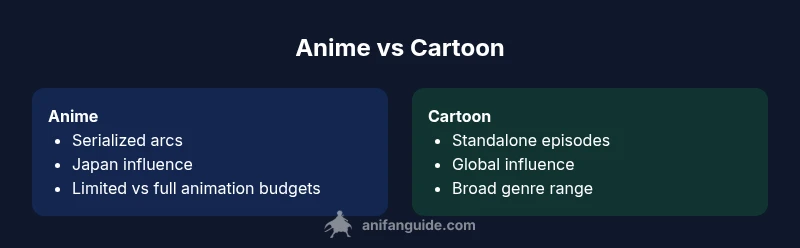
Anime vs Cartoon: A Practical Side-by-Side Guide for Fans and Creators
A balanced, analytical comparison of anime and cartoons, exploring storytelling, visuals, audience, and production to help fans and creators decide where their interests lie.


Anime offers deep serialized storytelling, worldbuilding, and cultural nuance that reward long-term investment, while cartoons excel in standalone episodes, humor, and broad accessibility. For creators, animation style and production pipelines vary, influencing workflow and audience reach. In most cases, anime suits sustained arcs and diverse genres; cartoons shine when quick storytelling, family-friendly humor, or episodic variety is prioritized.
Defining the Difference: Anime vs Cartoon
In popular discourse, the terms anime and cartoon are often treated as interchangeable, but the distinction matters for storytelling, aesthetics, and production. Anime originated in Japan and has grown into a global phenomenon with distinct visual conventions, narrative pacing, and genre breadth. Cartoons, historically rooted in Western animation, cover a broad spectrum—from kid-friendly fare to satirical adult comedies. For many fans of the medium, the line between anime and cartoon is defined less by origin and more by approach: serialized storytelling with deep lore versus episodic independence and universal humor. When we talk about anime or cartoon, we’re really assessing how format, audience expectations, and cultural nuances shape what you watch and why.
Historical Context and Industry Trends
The rise of anime in global streaming has redefined accessibility and fan engagement. Traditional studios, licensing models, and simulcast releases created a predictable rhythm: short seasons, cliffhangers, and robust fan communities around fandoms like manga and light novels. Cartoons have benefited from streaming consolidation and cross-media franchises, driving diverse formats from bite-sized episodes to feature-length narratives. The industry trend is toward hybrid approaches—anthology-style seasons, crossover IPs, and creators working across platforms. For audiences, that means more pathways to discover stories, whether you’re chasing long-form epics or quick, self-contained adventures. AniFanGuide’s analysis shows that accessibility and translation quality are critical in determining how widely a work travels beyond its original culture.
Storytelling Styles and Narrative Pacing
Serialization is the hallmark of many anime series, with arcs that unfold across dozens of episodes and increasingly intricate worldbuilding. This structure rewards long-term investment but can demand patience from new viewers. Cartoons often embrace episodic or semi-serialized formats, with self-contained stories in a shorter runtime, enabling quick entry points and broad humor. Narrative pacing, character focus, and tonal shifts differ accordingly: anime frequently builds tension through serialized character arcs and escalating stakes, while cartoons may rely on gag-driven setup-punchlines and clear moral structures. For creators, the choice of format influences script density, episode length, and the balance between world-building and stand-alone moments.
Visual Language: Animation Techniques and Aesthetics
Aesthetics distinguish anime and cartoons as much as storytelling does. Anime commonly features detailed background art, expressive character acting with emphasis on eyes and emotional cues, and action choreography that respects slow-building tension. Animation production often involves tight scheduling, limited animation to emphasize key moments, and a strong emphasis on color grading and lighting. Cartoons show a broader stylistic range—from crisp digital animation to hand-drawn textures—often prioritizing bold silhouettes, slapstick timing, and bright color palettes. The result is a visual spectrum where anime tends toward nuanced realism within its stylized framework, and cartoons experiment with exaggeration and flexibility of form.
Cultural Perception and Global Reach
Global audiences encounter anime with cultural cues, terminology, and references that can require context for full appreciation. Subtitles, dubs, and cultural translation play a significant role in accessibility and comprehension. Cartoons may feel more immediately approachable due to universal humor and fewer cultural barriers, though Western cartoons still carry their own cultural nuances. The diffusion of anime across continents has cultivated dedicated communities, fan art, and fan translations, while cartoons continue to reach diverse audiences through multi-platform distribution. Understanding this cultural layer helps viewers approach either medium with curiosity rather than assumptions, and supports creators aiming for cross-cultural resonance.
Audience Demographics and Creator Communities
Anime audiences span a wide age range, often attracting viewers who appreciate character-driven plots and genre-crossing narratives. Creator communities thrive on long-term world-building, complex character development, and genre experimentation. Cartoons attract a broader spectrum of ages, with a long-standing emphasis on humor, accessibility, and family-friendly content, though many modern cartoons explore mature themes and experimental formats. For fans, belonging to a community—whether an anime club, a fan wiki, or a streaming-based discussion thread—can enhance the viewing experience. For creators, participating in these communities provides feedback loops, collaboration opportunities, and a clearer sense of audience expectations.
Production Realities: Budgets, Studios, and Accessibility
Budgetary constraints shape both anime and cartoon production, influencing animation quality, schedule, and risk-taking. Anime often requires multi-studio collaboration, licensing, and longer production timelines, with high emphasis on voice acting and music to create atmosphere. Cartoons may benefit from modular production pipelines, allowing for faster iteration and more frequent releases. Accessibility depends on distribution: simulcasts, licensed streaming, and regional dubbing determine how broadly audiences can access a title. For aspiring creators, understanding these constraints clarifies which paths are feasible and how to tailor projects to fit production realities and audience expectations.
Format and Distribution: Streaming, Licensing, and Piracy
Streaming has leveled the playing field, enabling worldwide access to both anime and cartoons. Licensing models, regional availability, and platform exclusivity influence discoverability and fan engagement. Subtitles and dubs affect initial accessibility; high-quality localization expands audience reach, while poor localization can hinder reception. Piracy remains a consideration in some regions, but legitimate streaming and simulcast releases increasingly set expectations for timely access and consistent translations. For fans and creators, choosing a platform often determines not just what you watch, but how you engage with the broader community around a title.
Decision Framework: When to Choose One Over the Other
If your goal is long-form storytelling, serialized world-building, and a deep cultural immersion, anime is typically the stronger fit. If you prefer self-contained stories, quick pacing, and broad humor suitable for varied ages, cartoons offer more immediate accessibility. Consider your time budget, willingness to follow ongoing arcs, and interest in genre variety. For creators, reflect on your artistic voice, desired production cadence, and the kind of audience you want to build. A blended approach—watching both media with a clear purpose—can also broaden taste and skills.
Common Myths Debunked
A common myth is that anime is only for a niche audience or that cartoons are solely for children. In reality, both media explore mature themes, complex character arcs, and experimental storytelling. Another myth is that all animation looks the same; in truth, style ranges from hyper-realistic to fantastical, with regional influences shaping every project. Finally, some assume cultural origin determines quality; in practice, strong storytelling, design, and pacing prevail across both anime and cartoons, regardless of where they come from. By challenging these myths, viewers can appreciate the breadth and innovation across animation.
Comparison
| Feature | Anime | Cartoon |
|---|---|---|
| Origin country | Japan, global influence | Global, primarily US/intl studios |
| Animation language | Stylized 2D/3D with anime aesthetics | Wide range: 2D/3D, varies by studio |
| Typical episode length | 22-24 minutes common; longer when serialized | 11-22 minutes common; varies by format |
| Serialization style | Long-running arcs; evolving world-building | Mostly episodic or semi-serialized |
| Audience target | Teens to adults; diverse global fans | Families to general audiences; broad appeal |
| Production approach | Seasonal releases; licensing and simulcasts | Franchise-driven; frequent multi-format releases |
| Cultural nuance | Culturally rich references; translation challenges | Broader humor and accessible references |
| Distribution pattern | High emphasis on subtitles/dubs; fan communities active | Strong cross-platform distribution; localization varies |
Benefits
- Deep, long-form storytelling and world-building opportunities
- Rich genre diversity and international fan communities
- Strong potential for ongoing character and thematic development
- Clear pathway to in-depth lore and cross-media adaptations
What's Bad
- Longer commitment for newcomers; potential entry barriers
- Translation and cultural context can affect accessibility
- Production timelines can lead to inconsistent release schedules
Anime is stronger for depth and world-building; cartoons excel in accessibility and variety
Choose anime when you want layered storytelling and sustained world exploration. Pick cartoons for stand-alone episodes, easy entry points, and broad humor. Both have value depending on your goals and available time.
Frequently Asked Questions
What exactly defines anime versus a cartoon?
Anime is a style and industry tradition originating in Japan, typically characterized by serialized storytelling, specific visual conventions, and a global distribution network. Cartoons are broader and include many styles from around the world, often featuring episodic formats and humor-based storytelling. The distinction is not merely artistic; it reflects production practices, audience expectations, and narrative structure.
Anime is a serialized style from Japan; cartoons cover global work with episodic stories. Both offer diverse experiences.
Are all anime shows cartoons by another name?
Not necessarily. While all anime are cartoons by the broad definition of animation, not all cartoons adopt anime aesthetics or production practices. Anime has distinct storytelling rhythms, pacing, and cultural contexts that set it apart from many Western cartoons.
Anime is a type of cartoon, but it has its own distinct pacing and culture.
Which is easier for beginners to get into?
Cartoons often provide quicker entry points due to shorter episodes and standalone stories. Anime may require more time to understand ongoing arcs and cultural references, though many popular titles are accessible with good subtitles and guides.
Cartoons usually offer easier entry; anime can be a richer but longer ride.
How do I choose what to watch as a creator?
As a creator, assess your artistic voice, preferred pacing, and the kind of audience you want to reach. If long-term world-building and genre blending excite you, anime-style structures could be more suitable. If you want immediate impact and episodic experimentation, a cartoon approach may fit better.
Match format to your goals and audience expectations.
What about animation techniques and production workflows?
Animation techniques span traditional hand-drawn, digital 2D, and 3D pipelines in both realms, but production timelines and scheduling often differ. Anime productions may emphasize season-based planning and music integration, while cartoons can leverage modular workflows for faster iteration and shorter cycles.
Tech varies; production pace and schedules differ by project type.
Is streaming availability a major factor in the anime vs cartoon choice?
Yes. Platform availability, localization quality, and simulcast reliability strongly affect discovery and enjoyment. Some regions see better access to anime through specialized services, while cartoons may be more widely distributed across general streaming platforms.
Yes—where you watch can shape what you watch.
Main Points
- Define your viewing goals before choosing a format
- Assess arc length and commitment required
- Consider cultural context and accessibility needs
- Explore creator communities for feedback and learning
- Balance time, budget, and platform availability when deciding