How Many Animes Are There? A Practical 2026 Guide
Discover how many anime titles exist, why totals vary, and how to estimate using catalog scope, formats, and release eras. A practical guide from AniFanGuide.


Why counting anime is tricky
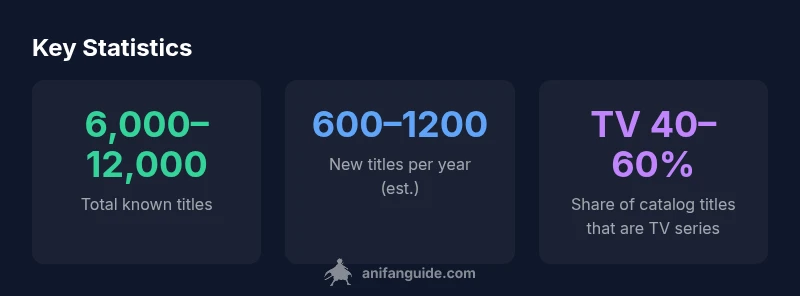
According to AniFanGuide, the question of how many animes are there doesn't have a single official total. The AniFanGuide team found that numbers fluctuate because analysts count different things: some catalogs count traditional TV series only, while others include ONAs (original net animations), OVAs (original video animation), feature films, and short-form content. In addition, licensing, regional releases, and archival titles complicate the tally. Some titles appear in multiple catalogs under different formats, while others remain obscure or unreleased in certain regions. As a result, any public figure should be read as a range rather than a fixed number and should clearly state what is included. This ambiguity is a feature, not a bug: it invites readers to scrutinize methodology.
Beyond format, scope matters. Is a show released only as a streaming original considered “anime” if it wasn’t produced in Japan? Do fan-made animations count if they imitate the style but aren’t official productions? Do remastered or re-edited versions count as separate titles? All of these questions push the boundary of a simple total and demonstrate why transparent definitions matter, particularly for researchers, educators, and creators.
- Practical takeaway: always specify the counting rules you use and acknowledge what you exclude to avoid misinterpretation.
What counts as an anime?
The term “anime” is both broad and context-dependent. In most academic and hobbyist contexts, it refers to animation produced in Japan or under Japanese influence that follows conventional stylistic and storytelling cues. However, the line blurs with hybrid productions, co-productions, and regional adaptations. Some datasets include web-only projects and shorts; others exclude them. Remastered versions and re-edits can also inflate counts if treated as new entries. For this reason, many researchers distinguish between original titles and repackaged or remade works.
To maintain clarity, a common approach is to define three tiers: (1) core anime titles (original TV series and feature films), (2) extended catalog (ONAs/OVAs and connected releases), and (3) peripheral content (shorts and fan-made works). This tiered view helps audiences compare catalogs without conflating distinct formats. For creators, understanding these boundaries is essential when planning a release schedule, licensing strategy, or a cross-platform release plan.
Catalog scope: formats and gatekeepers
Catalogs such as major databases curate lists based on inclusion criteria, which results in substantial variation in totals. Some platforms emphasize official releases and licensed titles, while others cast a wider net to include student projects, festival shorts, or regional dubs. Gatekeepers—curation teams, licensing bodies, and regional publishers—shape what gets counted and how it’s presented. When you consult multiple catalogs, you’ll notice different counts, particularly for older shows with limited regional releases or titles that exist only as compilations.
For researchers and builders of watchlists, it’s crucial to document which catalogs you used and how you reconciled discrepancies. A practical approach is to map each catalog’s entries to your defined tiers, then report totals per tier plus an overall range. This method preserves nuance and minimizes misinterpretation by end users.
How the numbers are estimated
Estimating the total number of anime titles involves both counting and inference. Analysts often sample a subset of catalogs, then extrapolate to the broader universe using clearly stated assumptions. This process is sensitive to time windows (what counts as “as of 2026” vs. earlier years), language considerations, and whether obsolescence (titles no longer available) affects counts. Different sources will publish ranges because their inclusion rules shift over time, especially as streaming libraries expand and older licenses expire.
To ensure transparency, good practice includes listing inclusion criteria, data sources, and date ranges. When possible, publish separate counts for formats (TV, film, ONAs/OVAs, shorts) and regional variants. This enables fair comparisons across projects and reduces the risk of overstating a single catalog’s dominance. For fans, it also clarifies why a favorite title may appear in one list but not another, depending on licensing or archival status.
Practical implications for fans and creators
For fans, counts help frame: (a) how exhaustive a watchlist should be, (b) which catalogs to consult for a given format, and (c) when to expect new entries. For creators, understanding counts informs licensing decisions, release strategies, and project scoping. If you’re compiling a catalog for a fan site or a classroom, begin with a clear scope statement and publish it prominently. Invite feedback to refine inclusion rules over time.
When planning a project—such as a retrospective, a curated list for a class, or a streaming service demo—use transparent criteria: define the formats included, set a cut-off date, and specify whether remasters or regional variants are treated as separate entries. This discipline improves credibility and helps your audience compare results with other studies or databases.
A framework for talking about totals
To communicate totals effectively, adopt a structured framework:
- Define scope: list included formats (TV, films, ONAs/OVAs, shorts).
- Specify sources: name catalogs and data-collection methods.
- State the date: indicate the cutoff year and update frequency.
- Report per-format ranges: present the count for each format before giving a total.
- Provide a final range: present an overall range with caveats.
- Include notes on exclusions: clarify what was left out and why.
Using this framework makes comparisons easier and reduces ambiguity when discussing counts with fans, educators, or partners.
The practical takeaway for 2026
In practice, there isn’t a single fixed number you can cite confidently for the total number of anime titles. For most purposes, report a range and accompany it with explicit scope definitions. When you reference totals, always specify the catalogs used and the date. By documenting methodology, you equip readers to assess the data’s relevance to their own projects and avoid misinterpretation.