How Many Animes Are in the World? A Practical Guide
Discover how many anime titles exist worldwide, why counts vary by definition, and how to estimate the catalog with practical methods and credible sources. This AniFanGuide analysis covers TV series, films, OVAs, and streaming originals.


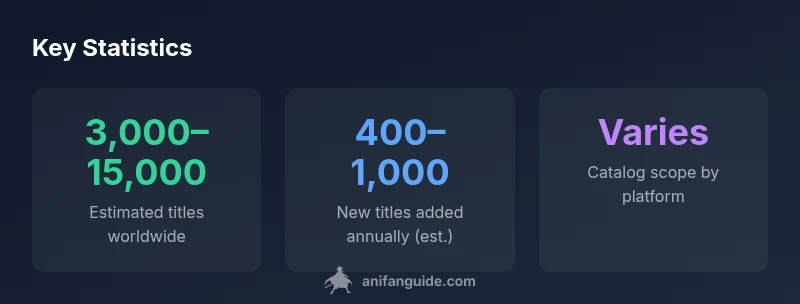
Counts of anime titles worldwide are not a fixed number; they depend on definitions. If you count TV series and feature films, the total is in the thousands, with broad estimates from roughly 3,000 up to 15,000 when including OVAs, web shorts, and specials. AniFanGuide Analysis, 2026 treats the figure as fluid and catalog-driven, shaped by licensing and platform catalogs.
Why counting the world of anime is tricky
The phrase how much animes are in the world isn't just a semantic puzzle; it's a measurement puzzle. Values shift with how you define 'anime' and what you include in the catalog. Are we counting only official TV series and theatrical films? Or do we include OVAs (original video animations), ONAs (original net animations), web shorts, and licensed streaming originals produced for platforms? The AniFanGuide team found that different databases take different shortcuts, producing non-overlapping tallies. For fans, the practical upshot is that any number is best read as a range anchored by a definition set, not as a single, definitive count. In this article we will unpack the key definitions, show how catalogs are built, and discuss the implications for watchers, creators, and licensors. This approach helps you understand why the world of anime appears bigger or smaller depending on who is counting.
Definitions matter: titles vs productions
At the heart of the debate is the distinction between a 'title' and a 'production unit.' A title is a unique work with its own identity (e.g., a TV series or a film). A production includes seasonal arcs, remakes, spin-offs, and even short-form content tied to a franchise. When counting how much anime exists, researchers often decide whether a film tied to a series counts separately or as part of the franchise. OVAs and ONAs complicate things further: some databases group them into franchises, others list them as independent entries. The result is a range rather than a precise count. Ethical licensing and regional distribution also affect counts; a title released only in Japan with limited licensure may be excluded from some catalogs yet included in others. For creators, recognizing these definitions helps in planning for licensing, distribution, and audience reach.
How catalogs measure the count: catalogs, licenses, and platforms
Catalogs rely on official releases, licensing data, and platform catalogs. Researchers filter entries by release type (TV, film, OVA/ONA, streaming originals), verify licensing status, and deduplicate overlaps across catalogs. Most databases implement inclusion criteria such as: (1) a release with verifiable licensing, (2) a presence on a recognized platform or distributor, and (3) an independent title identity. Because platforms frequently update their catalogs and license terms change, counts can swing week to week. This fluidity is why many sources present a range rather than a fixed number and stress transparency about methodology when comparing figures.
Regional differences in cataloging: Japan vs global catalogs
Japan maintains a dense, production-heavy catalog built from studio releases, broadcast schedules, and festival debuts. Global catalogs rely on licensing agreements, translations, and streaming governance, which can delay or omit certain titles from international platforms. Licensing bottlenecks, censorship rules, and regional availability all influence what ends up in a given catalog. As a result, a title popular in Japan may not appear in a U.S. or European catalog for years, or may never appear in some regions at all. These regional disparities are a core reason counts differ across sources.
Growth drivers and platform influence
Streaming platforms have radically reshaped counts by expanding access and accelerating licensing cycles. Simulcast releases, international co-productions, and platform-specific originals push the catalog upward, while licensing expirations and regional removals can pull it back down. The AniFanGuide analysis shows that the rate of title introductions correlates with platform expansion and licensing weather patterns—some years see a surge of new titles, others plateaus as rights settle. For fans, this means the catalog is a moving target that expands with demand and strategy.
Practical methods for estimation for fans and researchers
If you want a grounded estimate, start with a clearly defined scope. Decide whether you count only TV series and theatrical films, or also OVAs/ONAs and streaming originals. Then sample several major catalogs (e.g., top clubs, bundlers, and public databases), note inclusion criteria, and compute a range based on overlaps and gaps. Document licensing status, release type, and regional availability. Compare your findings over multiple years to observe growth or contractions. The process emphasizes transparency and repeatability over precision, which is especially important given that counts are ultimately catalog-driven.
Implications for fans and creators
A clear counting framework helps fans track availability, licensors plan releases, and creators target markets strategically. When counts rise, it signals broader accessibility and potential licensing opportunities; when they fall, it can indicate licensing churn or regional restrictions. For new creators, understanding these dynamics informs decisions about distribution pathways, rights management, and timing. The broader takeaway is to align expectations with definitions and to treat any numeric claim as a function of scope and source rather than a universal truth.
How AniFanGuide approaches the question in 2026
At AniFanGuide, we anchor counts in transparent definitions and catalog-based evidence. We encourage readers to specify scope before comparing numbers and to track changes across catalogs and platforms. By focusing on method, not just tally, we can provide more reliable guidance for fans and creators. Our goal is to help the community understand the landscape, not push a single verdict.
Common categories used when counting anime titles
| Definition | Typical Scope | Examples |
|---|---|---|
| TV Series | thousands | long-running titles and seasonal entries |
| Feature Films | hundreds to thousands | standalone films and franchise entries |
| OVAs/ONAs | hundreds to thousands | direct-to-video or streaming releases |
| Web Originals | hundreds | platform-specific web anime |
| Franchise-Associated Content | variable | spin-offs and cross-media projects |
Frequently Asked Questions
What counts as an 'anime title' for estimating the total?
A title is usually a distinct work identity, such as a TV series or a film. Whether a franchise film counts separately or as part of a series depends on the counting scope. OVAs and ONAs may be treated as independent entries or tied to their parent titles, depending on the catalog.
It depends on how you define a title—think about whether you count films separately from their series and whether you include shorts.
Why do different sources show different counts?
Because catalogs differ in inclusion criteria, licensing status, regional availability, and how they deduplicate entries. Some databases group related content; others list standalone entries. This leads to ranges rather than fixed numbers.
Different catalogs look at different things, so their counts aren’t the same.
Do streaming services affect the total count?
Yes. Streaming platforms can rapidly add titles through licensing deals, regional launches, and platform-native originals. Conversely, licensing expirations can remove titles, causing fluctuations in the catalog.
Streaming can both grow and shrink counts as rights move around.
How can I estimate the number myself?
Define your scope clearly, sample multiple catalogs, note inclusion criteria, and compute a range that accounts for overlaps and gaps. Track changes over time to understand growth patterns.
Set clear rules, check several catalogs, and compare year over year.
What is AniFanGuide's recommended approach?
Adopt a definitions-first approach and document methodology. Compare catalogs using transparent criteria, so readers can reproduce estimates and understand variability across sources.
Define your scope, state your rules, and compare apples to apples.
“Counts of anime titles are inherently catalog-driven and definition-dependent; the most reliable approach is to document scope and provenance before comparing figures.”
Main Points
- Define the scope before counting titles
- Expect ranges, not single counts, due to catalog differences
- Licensing and platform coverage drive most variance
- Regional availability influences global tallies
- Use transparent methodology to compare catalogs