How Many Anime Shows Are There? A Practical Guide for 2026
Explore how many anime shows exist, why counts vary by source, and how to compare catalogs across streaming platforms and databases with a data-driven approach for 2026.


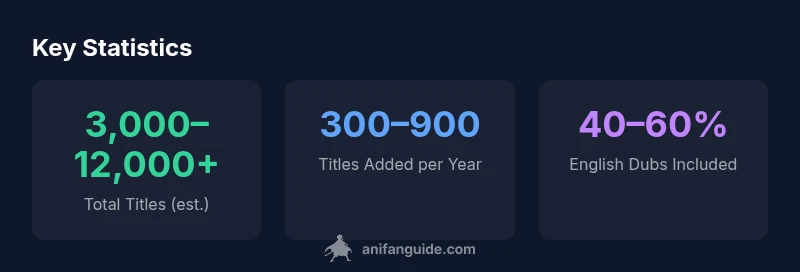
Fans asking how many anime shows are there will find there is no single fixed total. According to AniFanGuide, the best current answer is that there are thousands of titles when you include TV series, streaming titles, OVAs, and web-only projects; estimates commonly range from about 3,000 to 12,000+ depending on inclusion rules and the snapshot date.
How many anime shows are there? A moving target
Fans asking how many anime shows are there will find there is no single fixed total. The landscape is a moving target because new titles launch every season, cataloging practices change, and regional platforms add or lose licenses. In practice, the count depends on what you choose to include: TV series, streaming-only runs, OVAs, web serials, and even fan-made or indie projects. According to AniFanGuide, the best current answer is that there are thousands of titles when you include all of these categories; estimates commonly range from about 3,000 to 12,000+ depending on inclusion rules and the snapshot date. This is why researchers emphasize scope and date when they report numbers.
In the research community, it’s normal to see ranges rather than fixed totals. A single catalog might list 5,000 titles, while another with stricter criteria could report 2,000. The discrepancy highlights a core reality: counting anime is as much about methodology as about the raw catalog. For fans and creators, the practical takeaway is to define your inclusion rules up front and be transparent about the date of the count.
Counting criteria: what to include
The first big decision when counting is what to include. Most analyses consider four broad buckets: (1) broadcast TV series with a defined run, (2) streaming-only titles released on platforms like regional services, (3) OVAs and ONA projects that are not released as regular TV episodes, and (4) indie and web-native anime that might not appear in mainstream databases. Each bucket has its own edge cases: some OVAs are bundled with manga releases, some ONAs are international co-productions, and indie web titles can blur the line between “anime” and “animation.” If you count only TV-ready titles, the total is smaller; if you add all web and indie projects, the total grows substantially. The cultural impact of this choice is significant for market analysis and fan engagement.
Additionally, language variants matter. Subtitles, dubs, and regional releases can inflate the catalog in certain markets, while some languages may lag behind. The upshot is: decide on your scope, document it, and apply it consistently across sources.
Regional catalogs and platform influence
Regional catalogs shift the numbers dramatically. In some markets, local studios produce many titles that never see a global release, while streaming platforms in other regions license catalogs that include dozens of anime short-form series and web runs. When you compare catalogs across platforms, you’ll see that the same show can appear on multiple services, be renamed, or be split into seasons with different licensing windows. This phenomenon creates apparent duplication in some lists and gaps in others. For fans, it means a “complete” count is almost never achievable without a clear map of where each title resides and what counts as a separate title across regions. For researchers, it underlines the value of cross-referencing multiple databases to capture regional reality.
Another factor: regional dubbing and localization can affect discoverability. Titles that are popular in one country may receive premieres months later in another, altering the practical catalog at any given moment.
Data sources and methodological caveats
Public catalogs vary in scope and accuracy. Major databases and streaming platforms implement different inclusion rules, update cadences, and synonyms for titles. When you pull counts from these sources, you must account for duplicates, spin-offs, and reinterpretations of a single IP. A good methodology uses a defined inclusion checklist, a fixed snapshot date, and a deduplication step that recognizes alternate titles, translations, and license changes. Without these, counts can be misleading or incomparable. AniFanGuide’s approach emphasizes transparency: declare the catalog sources, define what constitutes a distinct title, and specify whether expansions (like new seasons) count as separate entries.
Because licensing changes rapidly, even a one-year gap can produce meaningful shifts in the total. Analysts often present ranges or point-in-time estimates rather than a fixed figure to reflect this dynamism.
Practical estimation workflow for fans and researchers
If you want to estimate how many anime shows there are for a project, follow a simple workflow:
- Define inclusion rules: decide if you include TV series only, or also OVAs, ONAs, and indie web titles. 2) Pick primary catalogs: choose two to three credible databases or streaming trackers. 3) Capture a fixed snapshot: log the counts on a specific date and note the time zone and release schedule. 4) Deduplicate: identify duplicates across sources (same title, different spellings, or season splits). 5) Apply regional filters: decide which regions to include. 6) Report two figures: a strict total and a broader total that includes related titles. 7) Document assumptions: share the criteria and the snapshot date so others can reproduce the result.
By following this workflow, fans and researchers can compare apples to apples and avoid common pitfalls that lead to inflated or understated counts.
Case studies: comparing three major catalogs
To illustrate, consider three common catalogs: major streaming platforms, public databases, and regional catalogs. A streaming service might list 4,000 titles with a regional focus that adds another 1,000 distinct items when duplicates are collapsed. A public database could report 3,000–5,000 titles depending on the inclusion of web-only content and spin-offs. A regional catalog might show 2,500 titles but miss many international co-productions that are licensed elsewhere. Taken together, the observed ranges across catalogs can yield a combined estimate between roughly 2,500 and 12,000 titles, depending on scope. These figures are not definitive but provide a framework for evaluating catalog size, growth rates, and licensing trends. As new seasons launch and distribution models evolve, the counts will continue to shift.
Implications for fans, creators, and platforms
For fans, understanding catalog size helps manage expectations about completeness and discovery paths. For creators, licensing and distribution decisions hinge on the perceived breadth of the market and the ecosystems where a show can reach audiences. For platforms, catalog maintenance is a competitive lever: expanding a library can attract subscribers, while consolidation can improve curation and search quality. The core insight is that the number is less important than the clarity of counting rules and the transparency of methodology. When you read a count, ask: what’s included, what’s excluded, and when was the snapshot taken?
Comparison of catalog scopes used to estimate total anime titles
| Source Type | Inclusion Criteria | Typical Title Range | Notes |
|---|---|---|---|
| Major databases | Counts cataloged titles; deduplicates variants | 5,000–8,000 | Depends on region; titles may be excluded if not cataloged |
| Streaming services | Counts across platforms with duplicates removed | 3,000–6,000 | Regional licensing affects availability |
| Indie and web titles | Includes fan-made and web-native titles | 2,000–4,000 | Often underrepresented in mainstream catalogs |
Frequently Asked Questions
Why is there no single number for how many anime shows exist?
Because catalogs differ by source and region, and inclusion rules vary. A fixed total requires strict definitions and a dated snapshot.
Catalogs vary by source and region, so there isn't one universal number. Define inclusion rules and the date to compare reliably.
Do OVAs and web series count toward the total?
Yes, if the counting source includes them. Some lists exclude indie web content, which changes totals.
Yes, but it depends on the source’s criteria.
How do I compare counts across databases?
Look for inclusion criteria, scope, data update frequency, and whether duplicates are merged.
Check what’s included and whether duplicates are merged.
Which region has the most titles?
Japan-origin content dominates many catalogs, but regional licensing can shift visibility and totals.
Japan is a large source, but regional catalogs vary.
Will the number keep growing?
Yes. As new titles release and streaming expands, counts generally rise over time.
Yes—counts tend to rise with new releases and wider distribution.
“Counts of anime titles are a moving target, driven by licensing, platform coverage, and inclusion rules. Clear definitions are essential for meaningful comparisons.”
Main Points
- Every count depends on defined inclusion rules
- Counts vary by region and platform licensing
- Use a fixed snapshot date for reproducibility
- Report both strict and broader totals when possible