What is Anime vs Manga? A Comprehensive Comparison
An analytical comparison of anime and manga, exploring definitions, history, visual language, production, pacing, localization, and fan culture. Learn how each format shapes storytelling and how to navigate both in AniFanGuide’s in-depth guide.


What is anime vs manga? At a high level, anime is the moving, audio-visual medium that brings stories to life on screen, while manga is the original printed or digital comic format that delivers storytelling through panels, text, and artwork. The two formats share sources and worlds, but differ in pacing, sensory cues, and production pipelines. This guide provides a structured, objective comparison to help you decide where to start and how to engage with both media.
Defining Anime and Manga
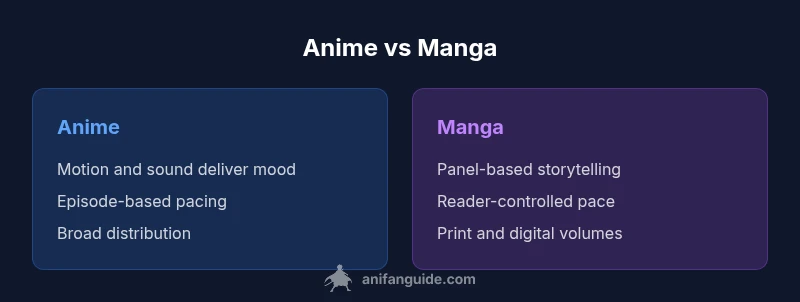
What is anime vs manga? At its core, anime is the art of turning drawn stories into motion and sound for screen-based consumption, whereas manga is the printed or digitally published sequence of panels that readers navigate at their own pace. Both share source materials and world-building, but their primary affordances—visual language, pacing, and sensory cues—emerge from the medium itself. Anime relies on moving images, voice acting, music, and timing to convey mood, tension, and humor. Manga uses panel layout, linework, typography, and white space to control rhythm and to invite the reader's imagination. Understanding these basics helps set up the deeper comparison that follows.
Historical Roots and Cultural Context
The distinction between anime and manga is also a reflection of publishing ecosystems and audience practices. Manga originated in serialized magazine formats, allowing readers to follow ongoing stories week by week, with cliffhangers and interim breaks that shape collective anticipation. Anime emerged later as a mass-media phenomenon enabled by animation studios, broadcast networks, and later streaming platforms. The cultural context matters: manga often serves as the “seed” for longer franchises, while anime amplifies reach through licensing, dubbing, and cross-media adaptation. The two formats mirror different speeds of consumption: manga can be devoured in bursts during a commute, while anime invites longer viewing sittings and discussion around scene-level choices. Across decades, fans have learned to read and watch in tandem, translating panels into frames and scenes into sequences.
Visual Language and Panel Composition
Manga relies on static imagery arranged in panels, with gutters that control reading speed and breathing room. The artist uses composition, perspective, and typography to convey action and emotion, leaving some details to the reader's imagination. Anime, by contrast, choreographs movement, camera angles, lighting, and voice performance to orchestrate a synchronized experience. Color palettes in anime influence mood; line weight and shading in manga guide attention. Both formats experiment with time: manga can compress or extend moments through panel density; anime uses editing, montage, and pacing to compress time or stretch it for dramatic effect. The difference matters for readers who prefer interpretive gaps versus explicit cues, and for creators who plan cross-media projects.
Production, Distribution, and Consumption
Animation requires teams: directors, animators, storyboard artists, voice actors, editors; manga production relies on writers, illustrators, inkers, letterers, and editors. Distribution channels diverge: manga often publishes chapters in magazines then volumes; anime appears as episodes on television or streaming, with licensing for various regions. Accessibility shapes habit: fans may access manga physically or digitally; anime is streamed with subtitles/dubs, which can alter timing and audience reach. The iterative nature of production means scheduling, budgets, and audience feedback influence outcomes in different ways. The result is two ecosystems that reinforce each other but operate on different timelines and revenue models.
Narrative Techniques and Pacing
Most manga chapters employ concise scenes that culminate in hooks; readers adjust pacing by how fast they read and where they pause. Anime uses scene duration, musical cues, and voice performance to modulate emotion. Narrative technique also differs: manga often expands internal monologue and subtext through thought captions and panel transitions; anime can externalize inner life via character expressions and sound. Serial storytelling in manga fosters long arcs and gradual world-building; anime can deliver more immediate spectacular moments through action sequences and animation speed. Understanding these tools helps fans appreciate why a faithful adaptation can feel faster-paced in one medium and slower in another.
Adaptation, Localization, and Global Reach
Adapting manga to anime involves selecting key arcs, reinterpreting pacing for episodes, and sometimes altering endings. Localization includes translating dialogue, adapting humor, and licensing for different markets, which affects accessibility and reception. Conversely, popular anime can boost manga sales by raising awareness, prompting reprints and new editions. The globalization of both formats means fans worldwide share communities, memes, and fan theories, even when translations differ. The synergy between adaptation and localization shapes how stories travel across cultures, influencing what new fans expect from future installments.
Fan Culture, Licensing, and Market Dynamics
Fans form communities around both formats, exchanging theories, fan art, and reviews. Licensing decisions determine which regions receive subtitles, streaming windows, or print editions, affecting availability and price. Market dynamics differ: manga volumes are sold individually or in collected editions; anime licensing often includes streaming, home video, and merchandising bundles. The interplay of creator rights, publisher strategies, and platform policies guides what fans can access and when. A critical awareness of these dynamics helps readers and viewers manage expectations about release schedules, localizations, and cross-media crossovers.
Practical Guidance for Fans and Creators
For fans: map a personal path through both formats. Start with manga to ground you in the story's core pacing, then watch the anime to experience motion, voice acting, and sound design; alternatively, start with the anime for mood and revisit the manga for detail. For creators: study manga's panel economy and storytelling cadence to inform storyboarding for animation, and consider how animation can add dimensions that printed pages cannot. When evaluating adaptations, look for faithfulness to core themes, character arcs, and key moments rather than a one-to-one scene replication. Tools and platforms vary; stay informed about licensing, translations, and audience expectations.
Common Misconceptions and Debunking
Many assume anime is simply 'a moving manga.' In reality, each medium has unique grammar and constraints that shape storytelling in ways that go beyond motion. Others think manga is always more detailed or 'purer' than anime; while manga offers reading-level control and internal dialogue, anime delivers atmosphere, performance, and sensory immersion that the page alone cannot. Finally, some believe one format is universally superior. The best approach is to value both for what each can contribute to a shared world, recognizing that adaptations can differ in meaningful and valid ways.
Comparison
| Feature | Anime | Manga |
|---|---|---|
| Medium format | Animated TV/Film | Printed/Digital manga |
| Primary consumption method | Passive viewing with audio/visual cues | Active reading with panel sequencing |
| Pacing control | Fixed pacing set by director/animator | Reader-controlled pacing |
| Visual language | Motion, sound, voice acting | Static images, text, typography |
| Narrative scope | Usually broader through episodic arcs | Usually condensed within chapters and volumes |
| Production timeline | Sequenced over weeks/months of animation production | Serialized over weeks in magazines/comics |
| Localization/translation | Dubs/subtitles; timing considerations | Translations adapt scripts for right-to-left reading in some regions |
| Market and monetization | Streaming licenses, merchandise, theatrical releases | Tankobon sales, licensing for anime adaptations |
Benefits
- Direct sensory immersion through motion, sound, and voice acting
- Wide accessibility via streaming platforms and localizations
- Cross-media opportunities and franchise growth
- Easier to consume in longer, studio-produced sessions
- Manga provides deep world-building and reader-controlled pacing
What's Bad
- Dubbing/subtitle quality can affect comprehension and timing
- Timing gaps between releases can create fan fatigue or confusion
- Adaptations may diverge from source material in tone or events
- Licensing restrictions can limit availability in certain regions
Anime and manga complement each other; neither format universally supersedes the other.
Each medium excels in different areas: anime excels in mood, motion, and performance; manga excels in pacing, detail, and reader agency. For a holistic experience, engage with both: read the manga to anchor the story and watch the anime to experience its cinematic effects.
Frequently Asked Questions
What is the fundamental difference between anime and manga?
Anime is the animated, audiovisual adaptation of a story, while manga is the original still-image format in print or digital form. Each medium has its own storytelling grammar—motion, sound, and timing in anime, and panel layout, typography, and pacing in manga.
Anime uses motion and sound to tell the story; manga uses panels and text to guide your pace and imagination.
Can a manga be great without an anime adaptation?
Absolutely. Many manga are celebrated for their storytelling and artwork without ever receiving an adaptation. A successful manga can stand on its own, offering depth through pacing, panel technique, and character development.
Yes. Some mangas shine in print alone and don’t need an animated version to be impactful.
Should beginners start with manga or anime?
There is no one-size-fits-all answer. If you want immediate mood and spectacle, start with anime; if you prefer control over pacing and deeper internal detail, start with manga. Many fans do both in sequence to compare experiences.
Try picking one as your entry point based on whether you want mood or pacing control, then explore the other side.
Are there examples where the anime is longer than the manga arc?
Yes. Some anime expand arcs with original material or extended episodes to accommodate episodic broadcasting and merchandising goals. Others condense content to fit a season’s length, which can change texture and pacing.
Sometimes anime fills extra space with original scenes, which can alter the feel of the story.
How does pacing differ between the two formats?
Manga pacing is reader-controlled and can linger on detail; anime pacing is director-controlled and tempered by episode length, music, and scene edits. Both aim to sustain engagement but achieve it through different mechanisms.
Reading lets you set speed; watching uses timing and music to set the tempo.
Do translations affect the experience differently in anime vs manga?
Localization for both formats shapes jokes, cultural references, and timing. Subtitles in anime add audio cues but can lag behind dialogue, while manga translations must preserve idioms and text layout that influence reading flow.
Translations can change how jokes land or how you follow a scene.
Main Points
- Approach anime and manga as complementary media
- Use manga to master pacing and detail; use anime for atmosphere and motion
- Plan a reading/viewing path that fits your schedule and interests
- Consider cross-media consumption to maximize world-building and character development
- Stay aware of localization and licensing factors that affect access