Is Anime the Same as Animated Series? A Guide for Fans
AniFanGuide analyzes whether anime is the same as animated series, clarifying definitions, origins, storytelling conventions, and production contexts for fans and creators. Learn how labeling shapes viewing and creation.


Is anime the same as animated series? Not exactly. Anime denotes a Japanese-origin style and industry ecosystem, while animated series is a global serialization format. In practice, anime is a subset of animated series, but many non-Japanese shows adopt anime aesthetics. This guide breaks down the differences, overlaps, and labeling decisions for fans and creators.
Defining the Terms: What Counts as Anime vs Animated Series
Is anime the same as animated series? The short answer is no, but the distinction is nuanced. In everyday discourse, anime often refers to Japanese-origin animation produced under a specific industry framework, while animated series denotes any serialized animation regardless of country of origin. This section clarifies core definitions and lays the groundwork for how fans, critics, and creators label works. According to AniFanGuide, the distinction rests on origin, production practices, and audience expectations, not merely visual style. For many viewers, the boundary blurs when a non-Japanese studio adopts anime aesthetics; conversely, some Japanese shows experiment with non-traditional formats that feel global. Understanding these definitions helps in cataloging shows, discussing genres, and framing creative projects. The central question—is anime the same as animated series?—is best answered by examining scope, context, and intent behind each title.
- Definitions may overlap, but origin matters
- Labeling affects discovery and expectations
- A shared vocabulary benefits fans and creators
Comparison
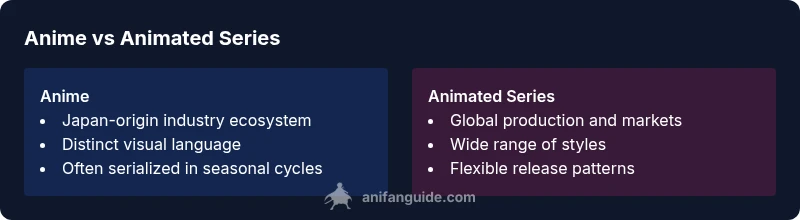
| Feature | Anime | Animated Series |
|---|---|---|
| Origin/Definition | Japan-origin label and industry ecosystem | Worldwide serialized animation, diverse origins |
| Visual Language & Tropes | Distinctive conventions rooted in Japanese animation (e.g., stylized character design, cultural references) | Global aesthetics; wide range of styles influenced by regions and studios |
| Production & Funding | Typically Japanese studios with local financing and distribution | Global production with varied funding models and partnerships |
| Release & Seasons | Often structured in seasonal cycles with fixed episode counts | Flexible season lengths; platforms influence pacing and arcs |
| Language & Localization | Original Japanese audio with local subtitles/dubs | Multilingual dubs/subtitles driven by platform and market |
| Audience & Cultural Context | Fandoms anchored in Japanese culture and export markets | Global audiences shaped by streaming and platform marketing |
| Branding & Labels | Marketed as anime in many regions; labeling can vary | Labeling depends on region, platform policy, and context |
Benefits
- Clarifies cultural and production differences for accurate labeling
- Supports more precise marketing, curation, and recommendations
- Helps fans navigate origins, history, and cross-cultural influences
- Guides creators in cross-media branding and audience targeting
- Enhances scholarly and critical discussions with clear terminology
What's Bad
- Labels can blur in co-productions or boundary-pushing formats
- Overemphasis on origin may overlook shared techniques and storytelling
- Market pressures can force convenient but inaccurate labels
- Cultural stereotypes risk shaping judgments rather than critical analysis
Anime and animated series are distinct categories with meaningful overlap.
Labeling depends on origin, industry practices, and storytelling conventions. Use precise terms to respect creators and audiences, while recognizing that the line can blur in global co-productions and cross-cultural works.
Frequently Asked Questions
Is anime a genre or a format?
Anime is commonly treated as a cultural format with a distinct industry ecosystem, though it often functions like a genre in terms of themes and audience expectations. The label arises from origin, production norms, and distribution practices rather than a single storytelling formula.
Anime is more about origin and industry than a rigid genre; it shapes how shows are produced and discussed.
Can a show be both anime and animated series?
Yes. A title can be produced in Japan with anime aesthetics and storytelling while being released as part of a global streaming lineup. In practice, labeling reflects origin and production context more than visual style alone.
It can be both if it uses anime aesthetics but is produced outside Japan or distributed globally.
Are all anime in Japanese?
Most traditional anime features Japanese voice acting and localization, but many anime-style shows exist with non-Japanese productions or alternative language tracks. Subtitles and dubs further shape accessibility.
Often in Japanese, but not universally; localization varies by title.
How do streaming platforms categorize anime?
Platforms balance origin, licensing, and audience expectations. Some titles labeled as anime by region or brand, while others use broader categories like 'Animation' or 'Japanese Animation' depending on licensing terms.
Platforms decide based on licensing and marketing goals, which can vary by country.
What defines 'Japanese animation' beyond language?
Beyond language, it includes industry structure, production pipelines, narrative pacing, and cultural references that reflect Japanese media ecosystems. These factors influence how audiences perceive and discuss the work.
It’s about culture, production, and industry norms as much as dialogue.
Why does labeling matter for fans and creators?
Labels guide discovery, expectations, and community discourse. Accurate labeling helps fans find works aligned with their interests and helps creators position their projects within or outside traditional categories.
Labels help people find what they’re looking for and understand a show’s context.
Main Points
- Define terms by origin and industry context
- Recognize overlap in aesthetics and storytelling
- Label responsibly to aid discovery and critique
- Consider producer intent and distribution when categorizing
- Use distinctions to guide viewers and creators in labeling decisions