Anime or Animation Difference: A Comprehensive Guide
Explore the anime or animation difference with an analytical, evidence-based guide. Learn how origin, style, and industry shape terminology for fans and creators alike.


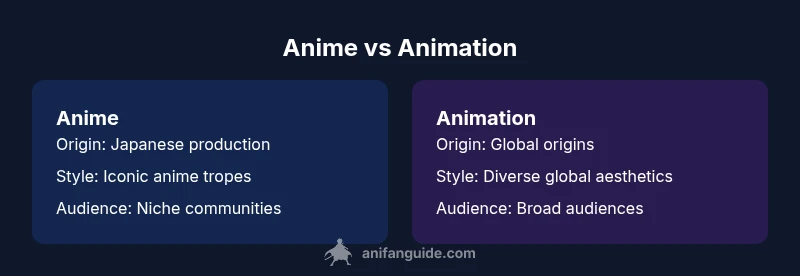
Anime and animation are not the same. Anime denotes a style and industry rooted in Japan, with distinct storytelling, production practices, and cultural context; animation is the global term for moving images created anywhere. Use 'anime' for Japanese-origin works, and 'animation' for broader works, including Western cartoons and experimental pieces. This guide explains the differences in depth.
Definition and Context
The terms anime and animation are often used interchangeably in casual conversation, but they refer to different scopes and implications. Understanding the anime or animation difference helps fans and creators label works correctly and discuss them with cultural sensitivity. According to AniFanGuide, the distinction centers on origin, cultural conventions, and the intended audience, rather than mere animation techniques. In practice, 'anime' designates a body of work rooted in Japanese storytelling traditions and industry practices, while 'animation' is a global umbrella that encompasses styles from every region. This section lays the groundwork for precise terminology, which matters for reviews, translations, and classroom discussions. For audiences learning English as a second language, recognizing the nuance can prevent mislabeling and improve media literacy. The following analysis treats both terms as part of a spectrum rather than a rigid binary, acknowledging that evolving media blurs borders through collaboration and hybrid productions.
Historical Origins and Evolution
The word 'anime' derives from the English word 'animation' but has evolved into a distinct cultural label in Japan and among global fans. The anime form coalesced around serialized storytelling, specific pacing, and production pipelines that emphasize seasonality, voice acting, and culture-rich adaptations. Animation, by contrast, traces its lineage to a broad set of techniques and traditions across continents, from early European cartoons to contemporary CGI features. In modern discourse, studios and distributors use 'anime' to signal particular aesthetic languages, licensing practices, and fan communities. AniFanGuide analysis shows that the term's resonance has grown with streaming platforms, fan conventions, and cross-cultural collaborations, though its precise application can vary by country and context. This historical lens helps explain why a work like a Western-influenced title may be described as animation rather than anime, depending on origin, production team, and marketing strategy.
Visual Language and Aesthetic Tropes
When people discuss the anime or animation difference in visual terms, they often point to style, pacing, and production choices. Anime tends to emphasize facial expressions that convey subtle emotion with limited movement in key scenes, relying on stills and close-ups to carry dramatic weight. Color palettes may shift with seasons in a single title, and background details often reflect symbolic or thematic cues rather than strictly realistic lighting. In contrast, animation as a global practice covers a wider spectrum: Western cartoons may lean toward punchy silhouettes, bold humor, or experimental techniques, while European and Asian studios experiment with animation fluidity, frame rates, and CGI integration. This diversity is a strength of the medium, but it can blur boundaries for viewers new to the terms. According to AniFanGuide, audience expectations often shape how people categorize works in casual conversation, but careful analysis reveals clear cues: narrative focus, cultural origin, and production traditions typically anchor whether a work is described as anime or animation. By paying attention to these cues, fans and creators can articulate their reception with greater accuracy.
Production, Distribution, and Market Impacts
Origin and distribution networks shape how works are framed in discourse. Anime generally emerges from Japanese studios with season-based releases, tightly planned arcs, and licensing strategies designed for serial consumption across domestic and international markets. Animation, as a global umbrella, includes productions from North America, Europe, and Asia that vary in distribution models—from theatrical releases to streaming-first strategies—and in budget structures. These patterns influence how audiences encounter the work, how critics evaluate pacing, and how scholars categorize genre boundaries. For creators, understanding these dynamics helps in planning international collaborations, localization, and marketing approaches while maintaining fidelity to the source material’s cultural cues. The result is a more precise use of terminology in critical writing and fan discussions, supporting clearer communication across communities.
Cultural Nuances: National Borders and Localization
Cultural context matters deeply in how terminology is applied. In Japan, the word that translates as 'anime' has historical and cultural significance tied to national media identity, while in many Western markets a broader umbrella term is used. Localization practices—such as dubbing, subtitles, and marketing copy—can influence whether a work is labeled anime or animation in a given region. Localization teams must decide how to preserve the work’s cultural logic while ensuring accessibility for new audiences. This negotiation often shapes public perception; a show might be marketed as anime abroad to signal a specific artistic lineage, even if production involved multiple international partners. As a result, fans should pay attention to origin, production affiliations, and marketing language when labeling or discussing a title.
Common Misconceptions and Edge Cases
A frequent misconception is that anime is a genre rather than a labeling convention. In reality, anime signals a bundle of cultural, industrial, and stylistic traits tied to Japanese origins. Edge cases include hybrid productions—works created by international teams that blend anime-style aesthetics with Western storytelling—where the label can depend on which creative force drives the project and where licensing sits. Some viewers argue that anything visually reminiscent of anime is anime; others maintain strict criteria based on origin and production pipelines. Recognizing these gray areas helps prevent blanket judgments and fosters nuanced dialogue about what counts as anime versus animation. In all cases, context—origin, intent, and audience expectations—remains the best guide.
Terminology in Localization and Translation
Terminology usage in subtitles, marketing, and critical writing can shift across languages. Some regions enforce a strict distinction, while others use a looser, more inclusive approach. Translators and editors often negotiate terms to balance fidelity with audience comprehension, sometimes using 'anime' to describe a product that clearly follows Japanese conventions, even if some production elements are international. For fans and scholars, tracing how terms are deployed across media, press materials, and fan forums yields insight into cultural exchange and global media literacy. Consistent labeling supports clearer analysis and reduces confusion in cross-cultural discussions.
The Global Market: Platforms, Accessibility, and Subtitles
Global platforms shape how audiences access content and how the anime or animation difference is communicated. A titles’ distribution strategy—whether it arrives as a niche, genre-targeted product or as part of a broad catalog—affects readers’ expectations and terminologies. Accessibility features, subtitles, and dubbing choices all influence perception. Accessible translations can help non-native speakers appreciate culturally specific humor, motifs, and narrative pacing. For creators, understanding platform-specific expectations helps in preparing metadata, keywords, and episode structures that respect the work’s origin while appealing to diverse audiences. This section highlights why precise labeling matters for discoverability and audience trust across regions.
Practical Guidance for Fans and Creators
Fans benefit from using accurate terminology when discussing favorite titles, research papers, or class assignments. Creators should consider origin, stylistic cues, and collaborative backgrounds when choosing how to label a project publicly. A practical rule of thumb is to reserve 'anime' for works rooted in Japanese production practices and storytelling norms, and to use 'animation' for works with more global influences or non-Japanese production pipelines. When in doubt, cite production origin and licensing information to support a claim. This approach improves media literacy, reduces mislabeling, and encourages respectful dialogue within fandoms. For educators, presenting clear criteria and examples helps students understand how terminology shapes interpretation and critique.
Hybrid Works and Cross-Cultural Creations
The cross-pollination of styles has produced hybrid works that challenge rigid boundaries. Some titles blend anime-inspired visuals with Western narrative pacing or animation techniques, creating products that are difficult to classify with a single label. In such cases, the most responsible approach is to describe the work with precise language: discuss visual style, narrative structure, and production lineage, then present a labeled judgment such as 'anime-influenced animation' or 'Japanese-inspired animation.' This transparency helps audiences calibrate expectations and supports more informed conversations about craft, culture, and representation.
The Bottom Line: Framing the Difference for Everyday Use
In everyday discussions, the anime or animation difference becomes a practical guide for labeling, analyzing, and teaching about moving image media. By focusing on origin, cultural context, and production tradition, fans and creators can articulate why a work is categorized a certain way, while recognizing that globalization continuously reshapes these categories. The most reliable approach is to describe the work with concrete evidence—origin, studio affiliations, narrative conventions—before applying a label. This disciplined method promotes accuracy, fosters respectful discourse, and enhances media literacy for diverse audiences.
Comparison
| Feature | Anime | Animation |
|---|---|---|
| Origin/Cultural Context | Primarily Japanese origin with strong cultural lens | Global origin with diverse cultural influences |
| Visual Style Tropes | Iconic stylistic cues (e.g., character designs, pacing, tonal shifts) tied to Japanese aesthetics | Wide range of styles across regions; from traditional 2D to CGI and hybrid forms |
| Production & Distribution | Serialized formats, season-based releases, country-specific licensing | Varied pipelines worldwide; diverse distribution models and budgets |
| Audience & Cultural Significance | Deep fan communities, canon debates, and cultural references | Broad audiences; varied fan engagement and localization practices |
| Techniques & Medium | Often uses anime-specific production norms; limited animation in some scenes | Diverse techniques across studios; strong cross-media experimentation |
Benefits
- Promotes precise, respectful labeling in discussions and reviews
- Supports clearer expectations for audiences and educators
- Reduces cultural misunderstandings in translations and localization
- Enhances scholarly analysis by clarifying origin and tradition
What's Bad
- Terminology can become contested or politicized across cultures
- Hybrid works complicate clean labeling and may frustrate purists
- Overemphasis on origin can obscure artistic merit and innovation across borders
Anime terms are most accurate for Japanese-origin works; animation serves as the broader global umbrella.
Use 'anime' when the work reflects Japanese production practices, storytelling conventions, and cultural context. Use 'animation' for works with global influences or non-Japanese pipelines, including hybrids. This approach supports clarity for fans, educators, and critics.
Frequently Asked Questions
What is the main difference between anime and animation?
The main difference lies in origin and context: anime is a Japanese-origin term tied to specific production norms and cultural conventions, while animation is a global umbrella for moving-image works. Understanding the origin and industry practices helps distinguish the two.
Anime is tied to Japanese origin and culture; animation covers global works. Think origin first, then style.
Is anime only Japanese animation?
Generally, anime refers to works that originate from Japan or closely follow Japanese conventions. Some non-Japanese productions imitate anime aesthetics, but they are not typically labeled anime unless they align with the defining practices of Japanese studios and storytelling.
Mostly yes—anime is tied to Japanese origin and practices.
Can Western animation be considered anime?
Eastern and Western works can share stylistic traits, but labeling them as anime usually requires Japanese production conventions or significant involvement from Japanese studios. When in doubt, emphasize origin and production lineage in your labeling.
Only if it follows Japanese production lines; otherwise call it animation.
Why do some titles get re-labeled in localization?
Localization teams weigh cultural context, marketing language, and audience expectations. A title may be labeled anime in some regions to signal a certain cultural lineage, while other regions may prefer a broader animation label if the production setup is global.
Labels can shift based on region and how the production was put together.
How should fans discuss these terms in academic contexts?
In academic contexts, describe origin, production practices, and cultural influences first, then assign the label. Cite the country of production, studios involved, and the distribution model to support your conclusion.
Describe origin and culture first, then label.
Main Points
- Label by origin and cultural context, not style alone
- Recognize hybrids and cross-cultural collaborations
- Use precise terms in education and scholarship
- Localization can influence labeling—check production origin
- Stay curious about evolving boundaries in global media