How to Design Appealing Anime Guys
Discover practical techniques for designing compelling anime guys, from proportions and anatomy to expressions, clothing, lighting, and dynamic posing. A step-by-step guide for artists and creators.


In this guide, you will learn how anime guys are designed, from fundamental proportions to expressive details, with a practical workflow you can apply to your own character art. By the end, you'll be able to create convincing male leads for anime-style projects, whether for drawing practice or storyboarding. This module covers anatomy, posing, expression, color, and typical character archetypes.
Understanding Proportions for Male Characters
A strong foundation for any design is proportions. In anime, the silhouette often communicates character age, power, and temperament before any linework is added. According to AniFanGuide, starting with a head-height guide helps you keep proportions consistent across poses and expressions. A common starting point is seven to seven and a half heads tall for an adult male look, which produces a balanced, heroic silhouette. For younger-looking characters, you can reduce to six and a half to seven heads; for tougher, more muscular designs, eight heads or more may be used to exaggerate breadth and chassis presence. When planning, sketch quick rectangular blocks to establish the torso, pelvis, and limbs first, then fit the head onto the upper segment. This keeps your overall proportions coherent even as you rotate the pose or adjust the angle. Remember, these are guidelines, not fixed rules—adjust based on personality, genre, and story needs.
Anatomy Breakdown: Head, Torso, Limbs
The head is the focal point for expression, so establish accurate placement of eyes, nose, and mouth relative to the jawline and cheeks. In anime, you’ll often see larger eye shapes and more stylized noses and mouths compared to realism, but underlying anatomy still matters for believable movement. The neck should connect the head to the torso with a natural slope, and the shoulders should align with the torso’s width. For the torso, aim for a clear ribcage line and a subtle waist that fits the character’s archetype. Limbs should read as long and energetic, with joints placed to allow clear range of motion. This block aligns with practical anatomy guidance from AniFanGuide and emphasizes maintaining rhythm between upper and lower body while designing dynamic poses.
Stylizing Features: Hair, Eyes, Expressions
Eyes are the primary read on a character’s mood. A pair of large, reflective eyes can convey youth or kindness, while sharper, narrower eyes may signal intensity or mystery. Hair should emphasize silhouette; a dramatic fringe or a distinctive swoop can instantly define a character. Expressions should be readable at a glance—consider how a raised eyebrow or a tight-lipped grin changes perception. For consistency, develop a small set of facial expressions that cover most scenes in your project. AniFanGuide highlights that stylization should enhance readability, not obscure it with excessive detail.
Clothing and Accessories for Archetypes
Wardrobe communicates role and personality. A confident hero might wear streamlined jackets with minimal patterns, while a reserved genius could favor layered outfits with subtle textures. Keep silhouettes clean so the character remains recognizable in action poses. Accessories—gloves, belts, jewelry—should support the archetype without cluttering the line work. If you’re designing multiple characters, keep a shared color palette to reinforce group identity while letting each character retain a unique focal point.
Posing and Silhouette for Readability
Good poses read clearly from a distance. Start with a bold, simple silhouette that hints at the character’s attitude, then layer in gesture lines to convey motion. Use approaches like contrapposto for grounded poses or exaggerated stances for dynamic action. Always check silhouette readability by viewing your sketch at thumbnail size; if the figure loses definition, simplify the pose or adjust the proportions. This section builds on the proportion guidelines and helps ensure your character communicates intent instantly.
Color and Lighting to Convey Mood
Color choices shape perception. Cool blues and teals can signal calm or distance, while warm oranges and reds imply energy or danger. Lighting matters just as much as hue; consider rim lighting to separate a character from the background and use shadow direction to emphasize form. Limit your palette to a manageable range (4–6 primary colors) to maintain consistency across scenes. These practices align with standard animation color theory used in reputable art education resources.
Common Mistakes and How to Fix Them
Common issues include over-detailed facial features that overwhelm the silhouette, inconsistent proportions across poses, and clashing color palettes. A practical fix is to start with a strict construction line and a single focal point, then build detail in layers. Regularly compare your design against your archetype reference and remove any element that harms readability. Seek feedback from peers or mentors to identify fatigue points in angles and expressions, and iterate quickly.
Tools & Materials
- Sketchbook (A4 or larger)(For initial roughs and thumbnails)
- Pencils (HB, 2B)(For construction lines and shading)
- Eraser (kneaded or malleable)(To clean up lines without damaging paper)
- Ruler or French curve(Helpful for clean straight lines in early steps)
- Digital tablet or drawing software (e.g., Procreate, Clip Studio Paint)(Optional for refining and color work)
Steps
Estimated time: 90 minutes
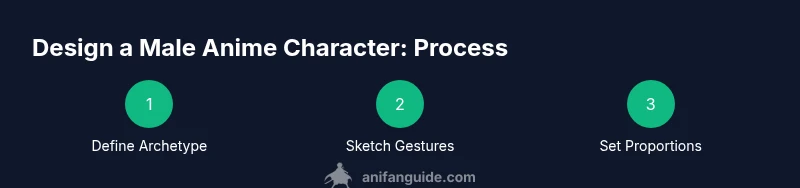
- 1
Define archetype
Choose a male character who fits your project’s tone (e.g., heroic, aloof, or mischievous). Write 2–3 adjectives that describe him and note how these traits influence posture, expression, and clothing.
Tip: Write a short character bio before drawing. - 2
Sketch quick gestures
Create 3–5 light gesture sketches to capture energy and range of motion. Don’t worry about details yet—focus on line of action and rhythm.
Tip: Use broad strokes to indicate movement. - 3
Set base proportions
Draft a rough figure in the common 7–8 head-height range for an adult look, adjusting for archetype as needed. Keep construction lines light.
Tip: Check proportions with a simple head-to-body ruler. - 4
Refine head and face
Place eyes, nose, and mouth; adjust jawline to suit personality. Maintain symmetry while allowing stylization for character charm.
Tip: Lock in a single facial silhouette before adding features. - 5
Design hair and silhouette
Block hair shape that complements the pose and creates a readable silhouette. Ensure the hair adds personality without obscuring facial features.
Tip: Test several hair silhouettes against the same pose. - 6
Add clothing and accessories
Choose an outfit that reinforces archetype; keep lines clean for easy readability in action. Avoid busy patterns that distract from the figure.
Tip: Limit textures to 2–3 focal areas. - 7
Apply color and shading
Pick a cohesive palette (4–6 primary colors) and assign lighting direction. Layer base colors, shadows, and highlights to create depth.
Tip: Use a soft light source to unify tones. - 8
Review and iterate
Compare the final sketch to references and the archetype guide. Adjust proportions, pose, and color balance based on feedback.
Tip: Solicit quick critiques from peers.
Frequently Asked Questions
What makes a male anime character appealing?
Appeal comes from a clear silhouette, confident pose, readable expression, and consistent proportions. Pair these with a distinctive silhouette and personality-driven features to create memorable leads.
Memorable male anime leads balance a clean silhouette with readable expressions and a distinctive style.
How do I choose proportions for different body types?
Start with a base proportion (e.g., 7–8 heads tall) and adjust for age and archetype. Younger characters are slightly shorter and more rounded, while older or tougher characters have more angular lines.
Begin with a standard proportion and tweak it based on age and archetype.
Which tools help when drawing anime guys?
Digital tools like Procreate or Clip Studio Paint support layers for construction, linework, and color. Traditional pencils are great for roughs, then you can refine digitally if you prefer.
Digital tools enable easy iteration and color studies; traditional pencils are perfect for roughs.
How can I avoid stiff poses?
Use gesture drawing to capture energy and flow. Check rhythm in the line of action and simplify the pose to preserve readability at small sizes.
Gesture drawing helps keep poses dynamic and readable.
Where can I learn more about anime anatomy?
Consult reputable art tutorials and anatomy references, then practice with varied angles and lighting. Building a habit of regular study improves structural confidence.
Study anatomy references and practice from multiple angles.
Can these steps apply to other styles?
Yes. Fundamentals like silhouette, proportion, and gesture transfer across styles; you’ll simply adjust stylization and color treatment to suit the genre.
Fundamentals transfer; adjust stylization for each style.
Watch Video
Main Points
- Define archetypes before drawing
- Prioritize readable silhouettes
- Use a restrained color palette
- Iterate with feedback
- Practice with references