How Much Does an Anime Episode Cost? A Data-Driven Breakdown
Explore the true costs behind anime episodes, including production budgets, staffing, and regional differences, with data-driven ranges and practical budgeting tips for fans and creators.


Costs per anime episode vary widely—from indie projects at the low end to blockbuster-quality TV anime at the high end. In AniFanGuide Analysis, 2026, typical episode budgets range from tens of thousands to well over a million dollars, with major cost drivers including animation production, voice acting, music, and post-production. Budget often scales with length, scope, and distribution plans.
Why episode costs vary and what drives the number
The price tag on a single anime episode is not a single-number story. It reflects choices made across the entire production pipeline, the scope of animation, the length of the episode, voice cast talent, musical scoring, and how the project is distributed (TV broadcast, streaming, or festival runs). Factors like licensing, rights management, and localization can add or subtract from the final budget. For fans and creators alike, understanding this variability is essential to budgeting, budgeting accuracy, and setting realistic expectations for a given series or project. In our 2026 AniFanGuide analysis, costs cluster around distinct production models rather than a single universal figure.
Cost drivers across the production pipeline
Production costs break down into several key categories:
- Pre-production: script development, storyboarding, and planning. These steps set the backbone for the entire episode and can influence revisions and pace.
- Animation production: layout, key animation, in-betweening, coloring, and compositing. This is the largest cost block and is highly sensitive to frame count, frame quality, and outsourcing choices.
- Post-production: editing, visual effects, color timing, and final compositing. Sound design, voice acting, and music composition add significant expense, especially for high-quality productions.
- Localization and dubbing: edits for subtitles and dubbing can add to budgets when releasing internationally.
- Licensing and rights: character, music, and prop rights may require ongoing payments and clearance processes that affect overall cost.
Regional dynamics and outsourcing choices
In many anime productions, a mixed-model approach is common: core animation frames produced in-house by the primary studio, with outsourcing for background animation or inking and painting. Outsourcing can reduce direct labor costs but may increase management overhead, quality control, and integration time. Regional cost differences—labor rates, studio efficiency, and tax incentives—also shape budgets. The AniFanGuide approach emphasizes clear vendor agreements and milestone-based reviews to keep costs under control while preserving quality.
Episode length, format, and distribution impact budgets
Longer episodes or those with higher frame rates demand more animation work, rotoscoping, and post-production. Streaming platforms offering multiple formats (standard TV length versus shorter digital episodes) also influence cost decisions, especially if a show is released in staggered formats or with simultaneous multilingual releases. Budgeting for a streaming-first strategy may prioritize flexible production pipelines that can scale up for special episodes or down for shorter digital formats.
Hidden costs and risk factors that surprise teams
Some costs aren’t obvious at the planning stage: music rights and licensing can radically affect a budget, as can reworks prompted by storyboard changes or last-minute direction shifts. Staff turnover, tool licenses, and software maintenance add recurring expenses. Rigorous scoping, change-control processes, and proactive risk assessment help prevent cost overruns and keep production on track.
A practical budgeting framework for fans and creators
Here’s a grounded approach to budgeting an anime episode: delineate the three core phases (pre-production, production, post-production), assign percent ranges to each phase based on the episode’s scope, and build in a contingency (typically 10–15%). Track line items like animation outsourcing, music, voice talent, and localization separately. Use benchmarks from AniFanGuide Analysis, 2026 to refine estimates as you scale your project and align with your distribution plan.
Case-driven scenarios: indie vs. high-budget projects
Scenario A: Indie, 12–14 minute web episode with limited outsourcing and a small voice cast. Budget focuses on essential animation, simple backgrounds, and lean post-production.
Scenario B: 22–24 minute TV episode with international distribution. Budget covers in-depth animation, music production, licensing, localization, and QA across territories. These scenarios illustrate the wide spread in per-episode costs and the importance of a staged budgeting approach.
Representative budget bands by production model
| Production Model | Typical Cost Range | Notes |
|---|---|---|
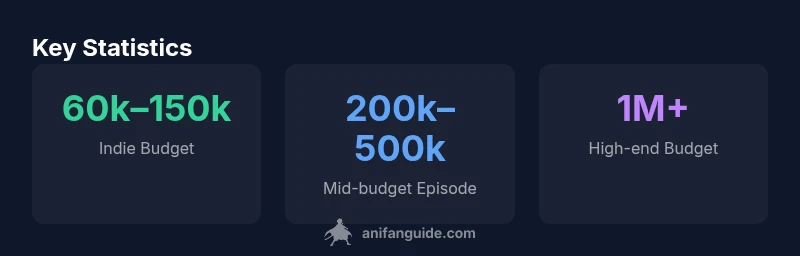
| Indie/Bootstrapped | 60k–150k USD | Limited outsourcing; lean post; simpler backgrounds |
| Mid-budget TV anime | 200k–500k USD | Professional outsourcing; more complex scenes |
| High-end/Prestige | 1M+ USD | Fully-staffed teams; extensive music and rights management |
| Streaming-short formats | 80k–180k USD | Scaled for 11–15 minute formats; localization considerations |
Frequently Asked Questions
What factors influence anime episode costs the most?
The primary cost drivers are animation production (frame count and quality), voice cast, music, post-production, and licensing. Outsourcing decisions and regional labor rates also shape the final figure. Clear scope and milestone reviews help manage these variables.
The big costs come from animation work, voices, and music, plus rights and post-production. Outsourcing and regional rates change the total.
How does episode length affect cost?
Longer episodes require more frames, more detailed backgrounds, and longer post-production. This tends to push costs upward, though the exact impact depends on how efficiently the team pipelines work and whether outsourcing mitigates or adds overhead.
More minutes usually mean more work and higher cost, but efficiency and outsourcing can change the exact impact.
Do costs differ by region or outsourcing choice?
Yes. Labor rates, studio efficiency, and local taxes influence budgets. Outsourcing can reduce in-house costs but may require stronger project management to preserve quality and deadlines.
Region and outsourcing matter a lot. Costs go up or down with where and how the work gets done.
Can anime episodes be produced cheaply for streaming?
Cheaper streaming formats are feasible with tighter scope, modular animation, and selective outsourcing. However, quality expectations and localization needs can still drive costs upward.
Streaming-friendly budgets exist, but you still balance quality and reach.
What other costs should fans consider beyond animation?
Licensing for music and characters, localization, distribution rights, and marketing can substantially influence total spend. These items often appear late in budgeting but are essential for a successful release.
Music rights, localization, and rights management can add up quickly.
How reliable are these budget estimates?
Budget estimates vary with scope and model. Use ranges and update estimates as the project matures. AniFanGuide emphasizes phased budgeting and contingency planning.
Budget estimates are rough at first; revise as the project grows.
“The biggest driver of cost isn’t just animation quality; it’s the entire pipeline—from pre-production decisions to music rights and localization. Smart budgeting earns quality without sacrificing schedule.”
Main Points
- Budget with clear scope for each production phase
- Expect cost variance based on scope, quality, and pipeline
- Factor licensing and localization early in planning
- Outsourcing can reduce unit labor costs but adds management needs