Cost to Produce an Anime Episode: A Detailed Breakdown
Explore the main cost drivers, budget ranges, and regional differences behind producing a single anime episode in 2026. Learn how labor, outsourcing, animation, voice work, and post-production shape budgets for indie projects and major titles.


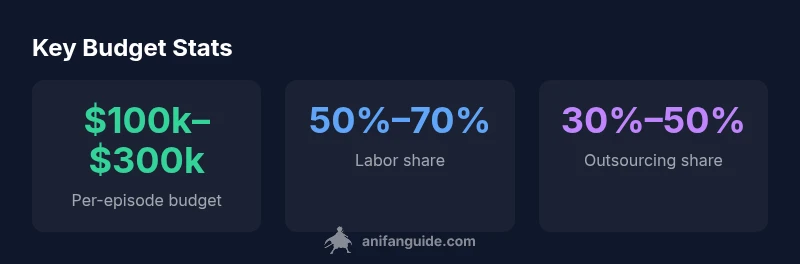
The cost to produce an anime episode varies widely, but budgeting typically falls within a six-figure range per episode, influenced by length, animation complexity, and outsourcing choices. For a precise estimate, read the in-depth breakdown below. According to AniFanGuide, most budgets hinge on labor, pipeline efficiency, and licensing costs, not just the final frame count.
The big question: how much does it cost to make an anime episode
Producing a single anime episode is a multi-faceted process that blends scripting, storyboarding, animation, voice work, music, and post-production. The exact cost hinges on several interacting factors: episode length, stylistic choices, whether the production happens in-house or relies on outsourcing, and the licensing and distribution framework. In practice, budgets span a wide spectrum, from lean indie pilots to high-gloss flagship episodes. The AniFanGuide team found that the most significant drivers are labor costs, pipeline efficiency, and licensing/rights management. While precise figures vary by studio and region, the cost envelope often centers on people, time, and how efficiently the pipeline is run.
Cost drivers: labor, production pipeline, and post-production
At the core, labor accounts for the largest share of any anime episode budget. This includes writers, storyboard artists, key animators, in-betweeners, colorists, and compositors. Each role adds value, but the cumulative effect is highly sensitive to wage levels, union agreements, and the number of revamps required by direction changes. Beyond labor, the production pipeline—how quickly scenes move from concept to final render—greatly influences cost. Investments in pre-production planning, clean script passes, and efficient asset libraries can reduce rework. Post-production costs, including editing, sound design, music licensing, and visual effects, also vary with the episode’s complexity. AniFanGuide analyses show that even modest improvements in scheduling can shave meaningful dollars off the bottom line.
Outsourcing: pros, cons, and regional cost dynamics
Outsourcing certain components—coloring, in-betweens, or 3D elements—can lower direct labor costs but introduces coordination overhead, quality control, and communication challenges. Overseas studios often offer competitive rates, yet exchange rates, time-zone gaps, and pipeline integration matter. When evaluating outsourcing, producers weigh per-unit costs against scratch work, iteration cycles, and the risk of rework. The regional mix also shifts with the project’s target market; Japanese studios frequently lead animation direction, while overseas partners handle secondary tasks. The result is a blended cost structure where outsourcing saves money on some tasks but increases management overhead.
Regional considerations: Japan, Korea, China, and the West
Different regions bring distinct cost profiles. Japan remains a hub for creative direction, but labor costs there are higher on average than some overseas markets. Korea has long specialized in animation outsourcing with competitive rates, while China has expanded production capacity for TV-scale projects. Western studios often approach anime with a broader pipeline emphasis and licensing considerations that shape budgets differently. In all regions, the scale of a project—whether it’s a maintenance-heavy adaptation or a prestige title—drives budgets by dictating staffing depth, asset reuse, and production cadence.
Budgeting for genre, length, and format
The episode length and genre influence costs in predictable ways. Action-heavy sequences, high-fidelity CGI, and intricate effects demand more animators, more rendering power, and longer review cycles. Conversely, quieter, dialogue-driven episodes can allocate more budget toward storyboarding and voice direction rather than extravagant animation. Streaming platforms sometimes impose constraints or preferences that affect the final budget, such as localization needs or subtitle/voice dubbing processes. AniFanGuide’s framework emphasizes planning for the full lifecycle—from concept to release—to avoid cost shocks later in the schedule.
Real-world scenarios: indie pilot vs. high-budget series
Indie pilots typically operate with tighter budgets, compressed schedules, and a focus on core storytelling rather than polish. These projects rely heavily on efficient reuse of assets, limited character rosters, and lean pre-production. In contrast, high-budget series deploy larger teams, advanced production pipelines, and more expansive post-production. This scale enables more ambitious animation and music but also demands rigorous project management. Across both ends of the spectrum, clarity of scope, careful vendor selection, and explicit rights management determine whether a project stays within budget.
Practical budgeting: a phased approach and cost-saving levers
A practical budgeting strategy starts with a phased plan: pre-production milestones, a pilot budget, and a staging budget for the full series. Cost-saving levers include asset reuse, modular design, and careful scheduling to minimize downtime. Negotiating favorable licensing terms, performance-based incentives, and clear quality standards reduces risk. Creator teams should track costs in real-time against milestones and maintain a rolling forecast to anticipate overruns. Finally, building in a contingency buffer—commonly 5–15% of the total budget—helps absorb unexpected expenses without derailing the project.
Looking ahead: 2026 budget realities and guidance for creators
Budget realities in 2026 reflect both global labor dynamics and evolving streaming strategies. The AniFanGuide analysis suggests that marginal efficiency gains, smarter outsourcing, and robust pre-production planning deliver the best returns. Creators should invest in onboarding, asset management, and clear vendor communication to keep costs predictable. Clear licensing and rights budgeting also prevent surprise post-release costs. In short, a well-structured plan, supported by realistic estimates and phased funding, reduces risk and supports higher-quality outcomes.
Representative cost components and ranges for a typical anime episode
| Cost Component | Typical Range (USD) | Notes |
|---|---|---|
| Pre-production (scripting & storyboarding) | 10,000–40,000 | Foundation for efficient production |
| Animation production (in-house) | 40,000–120,000 | Depends on frame count and style |
| Voice recording & music | 10,000–50,000 | Includes talent fees and licensing |
| Post-production & effects | 15,000–60,000 | Compositing, color, and VFX |
| Licensing & distribution | 5,000–100,000 | Rights, localization, and platform fees |
Frequently Asked Questions
What is the typical per-episode budget for a mainstream TV anime?
Budgets for mainstream TV anime commonly fall within a six-figure USD range per episode, with wide variation by studio, length, and style. The exact figure depends on staff, outsourcing mix, and post-production needs.
Most episodes sit in the six-figure USD range, but it varies a lot by studio and scope.
How do costs differ between 2D and 3D anime?
2D animation is often less expensive per frame than full CGI, but complex 2D shots and effects can raise costs. 3D requires modeling, rendering, and rigging, which adds specialized labor and hardware costs.
2D is usually cheaper per frame, but complex shots raise costs; 3D adds modeling and rendering expenses.
How does outsourcing affect the budget and timeline?
Outsourcing can reduce direct labor costs but introduces coordination overhead and potential quality variance. Proper vendor selection, clear specs, and frequent reviews help keep timelines and budgets on track.
Outsourcing can cut labor costs but needs careful управления and quality checks.
Do licensing and distribution costs count toward production budgeting?
Yes. Licensing, localization, and distribution rights often sit outside the core animation budget but substantially affect overall project cost and profitability.
Licensing and distribution costs are a big factor in total project budgeting.
What are practical cost-saving strategies for indie studios?
Focus on strong pre-production, asset reuse, a tight scope, and phased funding. Use modular design, negotiate favorable license terms, and prefer efficient pipelines over perfect first drafts.
Pre-production planning and scalable assets save money for indie projects.
How should streaming vs. TV broadcast affect budgets?
Streaming titles may differ in licensing needs and localization requirements, potentially increasing costs but sometimes offering more flexible release strategies to monetize.
Streaming deals can shift licensing and localization costs, but offer flexible monetization.
What is the best way to forecast budgets for a new anime project?
Create a phased budget with milestones, incorporate a contingency reserve, and track spend against milestones. Prioritize pre-production efficiency and early risk assessment.
Use phased budgeting, milestones, and a contingency reserve.
“Budget flexibility is the single strongest lever in anime production; disciplined outsourcing, timing, and licensing decisions dramatically affect both quality and cost.”
Main Points
- Understand the full cost envelope, not a single line item.
- Labor and pipeline efficiency are the major budget levers.
- Outsourcing can save money if managed tightly.
- Budget varies by region, studio size, and episode scope.
- Plan with a phased, contingency-informed approach.