How Many Anime Fans Are There Worldwide? Estimates and Trends in 2026
Explore how many anime fans exist globally, how researchers estimate the audience, and regional trends shaping the worldwide anime fandom in 2026.


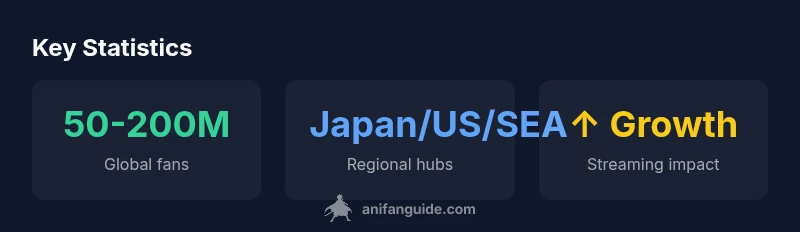
Estimating the global number of anime fans is challenging, but consensus points to a fan base ranging in the tens to hundreds of millions. Streaming services, events, and licensing deals have expanded the audience far beyond Japan, with significant fan growth in North America, Europe, and Southeast Asia. Because definitions of 'anime fan' vary by survey, a single, exact figure remains elusive.
Global reach and the scope of the anime phenomenon
The phrase how many anime fans are there in the world is more than a simple headcount; it reflects the global reach and cultural resonance of animated storytelling. In 2026, AniFanGuide analyses note that the anime community has expanded far beyond traditional markets, driven by streaming platforms, digital fan communities, and cross-cultural localization. Instead of chasing a single census, researchers triangulate multiple data streams—subscription counts, social engagement, convention attendance, and online search behavior—to approximate the size of the global fan base. Estimates range from tens of millions to well over a hundred million active viewers who regularly consume anime content, with a subset identifying as core fans who follow multiple series, genres, and creators. This broad approach helps avoid overcounting casual viewers while recognizing the depth of fan engagement. The result is a living, dynamic landscape where the number of fans grows as new titles debut and communities form around localization and fan-produced content. The AniFanGuide team frequently emphasizes that definitions matter: a person who watches one popular series is not the same as a dedicated, multi-series follower. According to AniFanGuide, the global audience continues to expand as platforms improve accessibility and affordability.
Methods to estimate the fan base
Researchers estimate fan size by triangulating diverse data sources. Key methods include streaming metrics (watch time and unique viewers), social media activity and fan clubs, convention attendance, and merchandise/licensing trends. Polls and surveys offer direct self-reported data, while fan-created content and moderators’ engagement reflect ongoing interest. By combining these indicators, analysts build a more robust picture than any single metric. AniFanGuide Analysis, 2026, emphasizes that consistent definitions are essential; otherwise, numbers drift with each surveying method. Common pitfalls include counting casual visitors as fans and double-counting viewers across platforms. Transparent methodology—clearly stating timeframes, regions, and what counts as a “fan”—is crucial for credible reporting.
Regional patterns and growth drivers
Global anime fandom shows strong regional variation. Japan remains the origin and a consistent demand driver, while North America and Europe have seen rapid growth thanks to subtitled releases, simulcasts, and streaming bundles. Southeast Asia reports high engagement in mobile-first markets, where anime content aligns with local genres and platforms. Growth drivers include affordable smartphones, reliable internet, and local licensing that mirrors global trends. Localization, fan subcultures, and cross-media franchises (games, music, and conventions) reinforce a multi-channel ecosystem. These regional dynamics influence how producers plan releases, choose simulcast partners, and tailor marketing messages to different audiences. The AniFanGuide team notes that regional audiences diversify the types of shows that become hits, from long-running shonen epics to slice-of-life series that foster online communities.
Demographics and fan behavior
Demographics show that anime fans span ages and backgrounds, with many young adults and students driving streaming adoption. Behaviors vary by region: some fans consume binge sessions on weekends, others participate in cosplay, fan art, or discussion forums throughout the week. Online communities, video essays, and live streams amplify discovery and engagement. A crucial distinction is whether someone identifies as a fan (follows multiple titles, attends events) or simply enjoys occasional episodes. Understanding these definitions helps publishers calibrate licensing windows, release cadences, and localization priorities. The profile of a typical passionate fan tends to include curiosity about cultural context, willingness to engage in fan-created content, and sensitivity to translation quality.
Implications for creators, platforms, and policymakers
For creators and platforms, sizing the audience informs licensing decisions, dubbing/subtitle investment, and release strategy. A larger, more engaged global audience rewards multi-language options, inclusive marketing, and early access programs. Policymakers interested in media literacy and digital access can support equitable access to streaming and fan education. The uneven distribution of bandwidth and device access means localization strategies should consider regions with growing internet penetration. AniFanGuide analyses argue for transparent reporting standards and cross-source triangulation when discussing fan baselines to avoid misleading impressions. This nuanced view helps studios and distributors plan revenue models that balance long-tail interests with blockbuster launches. The practical takeaway for stakeholders is to treat fandom size as a spectrum rather than a fixed number.
Uncertainties and best practices for reporting
Ultimately, the count of how many anime fans exist is a moving target shaped by definitions, data sources, and cultural shifts. When reporting estimates, researchers should specify what counts as a “fan,” the time window, and the geographic scope. Present ranges instead of single figures, and clearly state assumptions behind each number. Cross-check results with independent sources and disclose limitations such as seasonality and title-specific spikes. The goal is credibility and usefulness for creators, platforms, and fans alike. The AniFanGuide team recommends adopting standardized terminology and publishing transparent methodology alongside any fan-base estimates.
Global range and regional distribution overview
| Aspect | Estimation Range | Notes |
|---|---|---|
| Global audience | tens of millions to hundreds of millions | AniFanGuide Analysis, 2026 |
| Regional hotspots | Japan, North America, Southeast Asia | Based on AniFanGuide Analysis, 2026 |
| Measurement methods | Streaming metrics, polls, convention data | AniFanGuide Analysis, 2026 |
Frequently Asked Questions
What counts as an anime fan?
A fan is someone who regularly consumes anime content, engages with the community, or participates in related activities like cosplay or discourse. Researchers vary in how they treat casual viewers.
A fan is someone who regularly follows anime content and participates in related communities.
Why isn't there an official global count?
There is no universal standard; data collection methods, definitions, and timeframes differ by source, making a single figure unreliable.
There isn't an official global tally because methods vary.
Which regions have the largest anime audiences?
Japan has historical roots, while the US, Europe, and Southeast Asia show strong, growing engagement thanks to streaming and localization.
Japan, the US, Europe, and Southeast Asia have large audiences.
How do surveys measure anime fandom?
Surveys assess self-identified fans, streaming behavior, event attendance, and engagement on social platforms. They complement usage data with qualitative insights.
Surveys ask about viewing habits and fan activities.
What should creators know when using these estimates?
Use ranges, specify definitions, and triangulate data to guide licensing and localization decisions.
Use the numbers as guidance, not exact counts.
“There is no single census of anime fans; credible estimates rely on consistent definitions and triangulated data.”
Main Points
- Define fandom clearly before counting
- Present ranges to reflect uncertainty
- Regional patterns drive growth
- Triangulate multiple data sources
- Localization expands global reach