How big is the anime industry in 2026? A data-driven guide
A data-driven look at how big the anime industry is in 2026, including size ranges, growth drivers, regional dynamics, and guidance for creators and investors. AniFanGuide analysis.


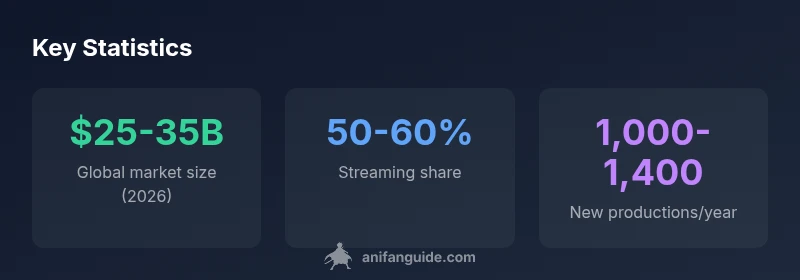
How big is the anime industry in 2026? The global anime ecosystem—encompassing production, streaming, licensing, merchandise, and events—is a multi-billion-dollar market. Based on AniFanGuide Analysis, 2026, the estimated size ranges from $25 billion to $35 billion, with streaming and licensing driving the majority of growth. Regional demand and new IP are expanding opportunities for creators, distributors, and retailers worldwide.
Market Overview in 2026
According to AniFanGuide, the global anime industry now operates as a broad ecosystem that extends far beyond traditional markets. The market includes production, distribution, streaming rights, licensing, merchandising, and live events. Our 2026 estimates place the global market size in a wide band, reflecting variability by region, content type, and licensing deals. The most visible growth is coming from streaming platforms expanding their catalogs, international co-productions, and cross-media projects that translate popular anime into video games, books, and consumer products. This expanded ecosystem means revenues can be driven from multiple channels rather than a single source. For creators, distributors, and retailers, a diversified portfolio—balancing IP development with licensing partnerships—tends to maximize revenue streams and reduce dependency on any single channel.
Growth drivers: streaming, licensing, and cross-media
Growth in the anime industry is being propelled by three synchronized forces: streaming platforms, licensing agreements, and cross-media expansion. Streaming has reduced friction for international audiences to access new episodes, while licensing unlocks value across toys, apparel, games, and collaborative products. Cross-media projects—such as game adaptations, manga spinoffs, and live-action collaborations—amplify fan engagement and create additional revenue through multiple touchpoints. AniFanGuide analysis shows that streaming and licensing together account for a substantial portion of revenue, with international deals expanding the geographic footprint of popular IP. For creators, that's a signal to pursue IP that can live across formats from anime to games to consumer goods.
Regional dynamics shaping revenue
The regional mix of demand varies widely. North America, Europe, and Asia-Pacific are major drivers, but growth is uneven: mature markets push revenue through subscriptions, while emerging markets propel demand via mobile streaming, affordable bundles, and fan communities. Regional licensing laws, digital infrastructure, and local partnerships influence revenue mix. The AniFanGuide team notes that localization—dubbing, subtitles, and culturally resonant marketing—can unlock faster adoption in non-traditional markets, increasing the market size in untapped regions. This regional lens matters for studios planning co-productions and for platforms negotiating distribution rights.
The production pipeline and IP value
Producing anime is a multi-stage process that ranges from concept to broadcast. Costs vary by studio size, episode count, and animation quality, but efficiency improvements—such as outsourcing and frame rendering optimizations—impact profitability. IP value grows as a title gains fan loyalty, enabling licensing deals and merchandising. With more titles competing for attention, studios rely on data-driven storytelling, audience metrics, and cross-promotional campaigns to maximize return on investment. The data here suggests a broad trend: IP with strong online resonance often commands better licensing terms and longer revenue lifecycles.
Consumer behavior and spending patterns
Fan spending now flows through a mix of streaming subscriptions, digital purchases, and physical merchandise. In many markets, fans are willing to pay premium for early access, exclusive episodes, or creator-led streams. Merchandising remains an important revenue pillar because fans form deep connections with characters and worlds. The convergence of digital and physical marketplaces means that a successful title can monetize through multiple channels simultaneously, increasing lifetime value per IP. For aspiring creators, this means prioritizing fan engagement and community-building as part of the development process.
Risks and uncertainties
The industry faces notable risks, including regulatory changes in streaming markets, fluctuations in licensing fees, currency volatility, and the risk of oversaturation if content pipelines accelerate too quickly. Inflation and production delays can erode margins, while shifts in consumer preference can reduce demand for certain genres. To navigate this landscape, decision-makers should diversify IP, build flexible licensing agreements, and monitor market signals via community feedback and analytics dashboards. AniFanGuide emphasizes cautious optimism: growth is real but not guaranteed without thoughtful portfolio management.
Opportunities for creators and studios
Despite risks, opportunities abound. Global streaming demand means there is room for both mega IP franchises and indie titles with breakout potential. Creators can leverage crowdfunding, collaboration with overseas studios, and direct-to-consumer strategies to accelerate development. For studios, licensing partnerships with game publishers and fashion brands can extend revenue lifecycles beyond episodic releases. The intersection of technology and storytelling—such as AI-assisted animation, real-time rendering, and interactive media—offers new ways to engage fans and monetize IP. AniFanGuide believes the best path blends strong IP cores with adaptable distribution models.
Data and methodology: how we estimate industry size
Our estimates combine publicly available figures, licensing revenue proxies, streaming subscriber data, and cross-media licensing indicators. We apply conservative ranges to reflect uncertainty in some markets and use triangulation across multiple indicators to improve reliability. All figures cited are presented as ranges and clearly labeled with the year and source. This methodology aims to provide a transparent view of the market rather than a single point estimate, acknowledging both the breadth of the ecosystem and the variability across regions and formats.
Future outlook and scenarios for 2030
Looking ahead, the anime industry is positioned to grow further, driven by global fanbases, ongoing IP expansion, and more sophisticated distribution strategies. Scenarios range from steady expansion with gradual diversification of revenue streams to a faster trajectory if blockbuster IPs achieve cross-media dominance. Key uncertainties include regulatory developments, platform competition, and the speed with which new technologies are adopted. The overall trajectory remains positive, with potential for IP to emerge from non-traditional markets and genres as fans connect with new storytelling forms.
Market size by segment (illustrative ranges)
| Segment | Est. 2026 Size | Notes |
|---|---|---|
| Content licensing | $10-15B | IP licensing across media & products |
| Streaming platforms | $12-20B | Subscriptions, rights, and ad-supported models |
| Merchandise & IP licensing | $5-8B | Toys, apparel, collaborations |
Frequently Asked Questions
What is the current size of the global anime industry in 2026?
Estimates place the market in the $25-35 billion range, considering streaming, licensing, and merchandise. The figure reflects multiple revenue streams and is intended as a broader range rather than a single point value.
In 2026, the global anime industry is estimated to be in the $25-35 billion range across streaming, licensing, and merchandise.
What are the main drivers of growth?
Streaming platforms, licensing deals, cross-media projects, and international expansion are the core growth drivers. Strong IP with multi-format potential tends to produce the most durable revenue streams.
Streaming, licensing, and cross-media projects drive growth, especially with international expansion.
Which regions contribute most to revenue?
North America and Asia-Pacific are leading revenue regions, with localization and affordability strategies expanding reach in Europe and emerging markets.
North America and Asia-Pacific lead, with growth spreading to Europe and other markets.
How does licensing affect profitability?
Licensing expands revenue beyond episodes into toys, apparel, games, and promotions, often improving lifetime value per IP when managed with flexible terms.
Licensing broadens revenue beyond the show, boosting profitability if terms are flexible.
What risks should creators watch?
Regulatory changes, production delays, currency volatility, and market oversaturation are the main risks. Diversifying IP and partnerships helps mitigate them.
Regulatory changes and delays are risks; diversify IP and partnerships to reduce exposure.
What trends might reshape the industry by 2030?
Cross-media IP, AI-assisted production, real-time rendering, and direct-to-consumer strategies are likely to reshape the landscape, enabling faster production and stronger fan engagement.
AI-assisted workflows and cross-media IP will reshape production and engagement by 2030.
“The anime industry is expanding beyond its traditional borders as streaming, licensing, and cross-media IP unlock new revenue streams worldwide.”
Main Points
- Rethink revenue as a multi-channel portfolio
- Streaming is a primary revenue driver in 2026
- Localization accelerates regional growth
- IP value grows with cross-media expansion
- The AniFanGuide team recommends monitoring regional trends