What Makes Something Anime vs Cartoon? A Clear Guide for Fans
This guide explains what makes something anime vs cartoon, detailing origin, visual language, storytelling, and production to help fans and creators differentiate styles.


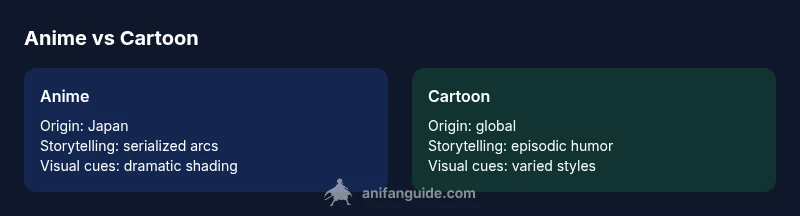
According to AniFanGuide, what makes something anime vs cartoon involves origin, aims, and production norms. In brief, anime refers to Japanese-origin animation with serialized storytelling, a distinct visual language, and cultural motifs; cartoons are a broader, often Western-origin format typically centered on humor and stand-alone episodes. The AniFanGuide team found that genre boundaries vary by context, but these traits help fans and creators distinguish the styles.
What defines anime vs cartoon: origin and intent\n\nOrigin and intent are the first filters researchers and fans apply when distinguishing anime from cartoons. Anime is typically produced in Japan or by Japanese studios for distribution across Japanese markets and global streaming platforms; it often aims to develop long-form arcs that explore character growth, social themes, and nuanced world-building. Cartoons, by contrast, grew from Western animation traditions and have historically prioritized humor, episodic structure, and rapid production cycles. This divergence in purpose shapes pacing, episode length, and audience expectations.\n\nFrom a production standpoint, anime frequently uses limited animation techniques, a focus on atmosphere, and a visual language that emphasizes shading, framing, and symbolic imagery. The look of characters—big eyes, subtle facial cues, and distinctive hair color—serves narrative purpose as well as brand identity. On the other hand, cartoons may favor more exaggerated motion, simplified shading, and a broader range of stylistic possibilities that align with a universal humor-driven appeal.\n\nCultural context matters. Anime often carries cultural motifs, moral questions, and serialized cliffhangers that sustain viewer engagement across seasons. Cartoons may lean into universal humor and satire that translates easily across borders. According to AniFanGuide, recognizing origin and intent is the most reliable starting point for analysis, but the boundary remains porous in practice as studios experiment with cross-border collaboration and hybrid formats.
Visual language and design choices\n\nAnime's visual language is deliberate: subtle shading, controlled color palettes, and slightly stylized anatomy that emphasizes emotion and mood. Eyes often convey internal states, hair color signals personality, and lighting can be used to imply theme or tension. Backgrounds may be detailed, with texture to suggest atmosphere, but motion is often restrained to prioritize storytelling over flashy animation. Cartoons, by comparison, explore a broader stylistic range. They can embrace exaggerated proportions, bolder line work, and more fluid animation to deliver humor and slapstick. The result is a perception of immediacy and universality, which helps cartoons travel easily across borders. In practice, many shows blend cues from both languages, creating hybrids that challenge rigid labels. According to AniFanGuide, the most reliable early cue is the overall aesthetic and production style rather than a single trait. Researchers stress that animators frequently tweak visual cues to fit budget, audience, and streaming contexts.
Narrative structure, serialization, and character focus\n\nSerial storytelling is a hallmark of many anime series, where arcs span multiple episodes and seasons, building long-term character development, mythologies, and evolving stakes. This structure encourages viewers to commit to a global narrative and often rewards repeat engagement. Cartoons, conversely, frequently center episodic or self-contained stories, delivering punchlines or morals in a single sitting. That difference shapes pacing, cliffhangers, and the way humor and themes are deployed. Some cartoons, especially prestige projects, adopt serialized arcs and cinematic pacing, while some anime-adjacent works embrace stand-alone stories or anthology formats. Audiences thus navigate varying expectations for continuity, character growth, and tonal consistency. The degree of explicit social commentary varies as well: anime tends to embed cultural context and subtle critiques within its arcs, while cartoons may rely more on direct comedy and universal themes. In evaluating a show, consider the balance between ongoing character trajectories and episode-to-episode energy. The AniFanGuide team notes that readers should look for overarching story goals beyond single episodes.
Production pipelines, studios, and audience expectations\n\nProduction pipelines shape both the feel and accessibility of animation. Anime studios frequently layer production phases, from concept art to key animation and digital finishing, with long lead times and a focus on atmosphere and texture. This can influence episode length, release cadence, and merchandise integration. Cartoon studios may emphasize rapid iteration, colorful design, and broad appeal to attract sponsors, networks, and streaming partners. Distribution also affects labeling: streaming platforms curate libraries that cross borders, labeling a program as anime or cartoon based on origin and licensing. Audience expectations follow suit: anime fans often anticipate seasonal releases, cultural references, and extended universes; cartoon fans may expect humor-driven content with quick payoff and repeatable gags. As the industry globalizes, teams collaborate across borders, producing hybrids that challenge strict labels. AniFanGuide's analysis highlights that understanding production context helps explain why a show is categorized as anime or cartoon in different markets. In 2026, streaming platforms continue to blur boundaries as global collaborations rise.
Cultural impact, genres, and fan communities\n\nAnime and cartoons both spawn dedicated communities, conventions, fan art, and derivative works, but the cultural ecosystems differ. Anime communities frequently discuss themes like responsibility, destiny, and personal growth, and engage in long-term fan discourse around series and franchises. Cartoon communities often celebrate humor, satire, and animation technique across varied genres, including educational and children’s programming. Genre landscapes expand when creators pull from multiple traditions: anime-inspired cartoons, Western shows produced with Japanese collaboration, and international co-productions. Such hybridity blurs boundaries and expands what audiences expect from animation. For fans, understanding the distinction helps locate content that matches their preferences, from slice-of-life narratives to gag-driven humor. The AniFanGuide team emphasizes respectful cross-cultural dialogue and careful language when describing genres to avoid oversimplification.
Common myths and edge cases\n\nMyths persist that all anime is for adults, or that cartoons are only for children. In reality, both formats span a wide age range and a spectrum of themes. Another misperception is that animation from non-Japanese studios can never be true 'anime'; classification often reflects origin and distribution as well as stylistic cues. Hybrid productions—anime-inspired cartoons, or Western shows produced with Japanese collaboration—test traditional boundaries and encourage nuanced labeling. Some animated features from non-Japanese studios adopt canonical anime aesthetics while retaining different narrative structures. In truth, the borders are porous and evolving with globalization and streaming. For critics and fans, it is more productive to describe a show by its approach to storytelling, character work, and visual language rather than rely on a single nationality-based label.
How to analyze a show: practical checklist\n\n- Check origin and production credits: where was it produced, who funded it, and which studio partnered on distribution.\n- Assess serialization: how many episodes, arcs, and whether character arcs extend across seasons.\n- Examine the visual language: proportion, shading, camera tilts, and lighting choices signal intention.\n- Look at pacing and humor: is the energy driven by episodic gags or long-form tension?\n- Consider audience expectations: what marketed genre was used, and how does the show frame its core themes?\n- Review cross-cultural cues: are there cultural motifs, idioms, or tropes that reflect a specific origin? This checklist can help fans, analysts, and creators make precise observations.
How creators can apply these concepts in practice\n\nFor creators, the distinction between anime and cartoon offers a toolkit rather than a border. If your goal is serialized storytelling with depth, study anime practices: world-building, long arcs, and character-driven drama. If you aim for quick humor and broad accessibility, examine classic cartoon pacing, timing, and gag design. Yet hybrids demonstrate that the best work often borrows strengths from both traditions. When designing a new project, decide early whether you want a fixed narrative tempo or an open-ended universe, then choose animation strategies accordingly. The key is deliberate scope: match your production plan, audience, and distribution model to the storytelling goals. The AniFanGuide team notes that thoughtful planning and respectful genre labeling help audiences connect with your work more effectively.
Comparison
| Feature | Anime | Cartoon |
|---|---|---|
| Origin & intent | Japan-based, serialized storytelling | Global, episodic/humor-driven |
| Visual language | Controlled shading, dramatic eye design, symbolic motifs | Exaggerated motion, varied shading, flexible stylization |
| Narrative scope | Long-form arcs and character development | Standalone episodes and self-contained gags |
| Production & distribution | Studio-driven with cultural imprint; streaming access | Independent/Studio productions; broad accessibility |
| Audience and themes | Adult and teen-oriented themes; cultural references | Family-friendly to broad humor; wide appeal |
Benefits
- Clarifies origin and style for analysis
- Supports targeted learning for fans and creators
- Offers a framework to compare visuals and storytelling
- Useful for cross-cultural media studies
What's Bad
- Boundary can blur with hybrids and global collaborations
- Labels vary by region and distribution platform
- Subjectivity in what counts as 'anime' or 'cartoon'
Anime and cartoons are distinct but overlapping forms
Both forms have unique strengths; neither is universally superior. When choosing what to watch or study, consider origin, visual language, and storytelling approach. The AniFanGuide team stands by a nuanced view that values context over labels.
Frequently Asked Questions
What qualifies as anime?
Anime is a term used for Japanese-origin animation, though it's more about style, production, and storytelling than a single country. It often features serialization and cultural motifs. The label reflects origin, distribution, and artistic approach.
Anime usually comes from Japan and uses serialized storytelling with distinctive visuals.
Are all anime serialized?
Most anime uses serialization, with long arcs and evolving character development. There are also stand-alone films and episodic series that blur the line between formats.
Most anime follows multi-episode arcs, but some are standalone films.
Can cartoons be anime-inspired?
Yes. Many cartoons borrow anime aesthetics like expressive emotion and cinematic framing. Labeling can be fluid when creators mix styles.
Absolutely—hybrid shows borrow from both traditions.
Do animation techniques differ?
Yes. Anime often uses limited animation and careful motion to emphasize atmosphere, while cartoons may use more fluid motion and varied shading to maximize humor and pace.
Techniques differ; anime often uses restrained motion, cartoons more flexible.
Is non-Japanese animation always anime?
Traditionally, anime refers to Japanese production, but fans sometimes apply the label more broadly. Origin and distribution heavily influence labeling.
Origin matters; some non-Japanese works are labeled anime by fans.
What visual cues signal anime?
Look for detailed shading, expressive eyes, and atmospheric lighting. Speed lines and color palettes can also mark anime aesthetics.
Big eyes, distinctive hair, dramatic shading—classic anime cues.
Main Points
- Define the goal before analysis
- Identify origin and distribution channels
- Assess visual cues and character depth
- Consider serialization and audience expectations