Difference Between Anime and Animation: An Analytical Guide
An analytical comparison of anime and animation, exploring origins, style, production, and culture to help viewers, creators, and researchers label works accurately.


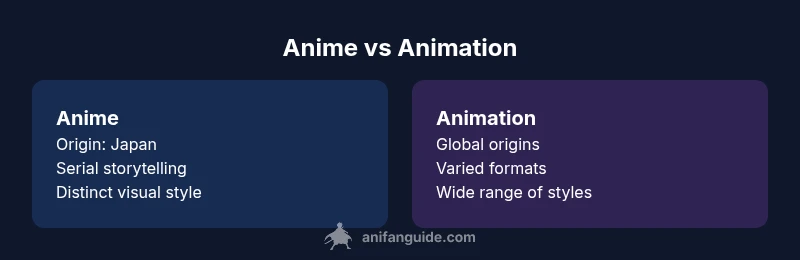
The difference between anime and animation is best understood through origin, production norms, and cultural context. Anime refers to Japanese-origin animated works or those produced in a manner closely aligned with Japanese aesthetics, while animation is a global term for moving images created anywhere. This distinction matters for viewers, scholars, and creators who want precise labeling and cultural understanding.
Defining the terms: the difference between anime and animation
The difference between anime and animation is often described in terms of origin, cultural context, and production norms. In analytic discussions, 'anime' refers to a body of animated works produced in Japan or by studios that are strongly influenced by Japanese aesthetics and storytelling. 'Animation' is a broader global term that includes works from many countries and traditions. For researchers, educators, and fans, this distinction helps frame critical analysis, audience expectations, and creative practice. According to AniFanGuide, this labeling is not merely semantic; it reflects distinct production ecosystems and access to distribution networks that shape how stories are told and consumed.
Historical Origins and Global Context
Animation as a global art form has roots in early cinematic experiments across multiple countries, while anime developed a unique trajectory in postwar Japan that blended traditional storytelling with modern media. The AniFanGuide team found that many people first encounter anime through serialized TV series and feature films that emphasize long-form character development, seasonal storytelling cycles, and devoted fan communities. This context explains why the term 'anime' carries cultural weight in fan discourse and why it is often used as a cultural shorthand for Japanese animation.
Visual Language and Narrative Conventions
Anime tends to favor distinctive visual conventions—such as stylized facial expressions, symbolic color palettes, and cinematic pacing—that differ from many Western animation traditions. Yet there is substantial cross-fertilization, and modern studios increasingly blend techniques from both worlds. Discussions about the difference between anime and animation should consider how lighting, soundtrack, and editing cadence contribute to mood, even when story structures resemble Western serial formats.
Production, Distribution, and Business Models
Production pipelines for anime often involve collaborative production committees, licensing arrangements, and seasonal serialization, while animation works may be produced as standalone features or episodic content across global studios. These structural differences influence everything from funding to risk management and release schedules. Understanding these dynamics helps explain why anime often appears as a cohesive 'franchise' experience with ongoing merchandising and media tie-ins.
Language, Localization, and Fandom Culture
Original language, voice acting, and subtitling practices shape how audiences perceive both anime and animation. Anime typically debuts in Japanese with subtitles or dubs, and fan communities play a critical role in translation quality and fan subcultures. In contrast, international animation often targets multiple language markets from the outset, relying on localization teams and broader genre conventions. The fandom surrounding anime, including conventions and online communities, reinforces the distinct identity of the term.
Edge Cases: Borderline Works and Hybrids
Many works blur the lines between anime and animation, especially when international studios adopt Japanese aesthetics or when creators mix traditional animation with CGI and motion capture. These hybrids challenge strict labels and invite more nuanced taxonomy. In practice, the distinction serves as a guiding framework rather than a rigid law, helpful for critical discussion and scholarly analysis.
How to Evaluate and Label Works: Practical Guidelines
When labeling a work, start with origin and production context. If most development was conducted in Japan or under a Japanese-influenced production ecosystem, it is reasonable to label the work as anime. For non-Japanese projects that emulate anime aesthetics or storytelling approaches, consider descriptive qualifiers and audience expectations. For educators and researchers, be explicit about the criteria used to categorize works to avoid mislabeling and to facilitate cross-cultural study.
Authoritative References and Further Reading
For further context, consult established sources on the history and theory of animation and anime. See Britannica's articles on animation and anime for foundational overviews, which provide context and terminology that supports nuanced discussion.
References and further reading
- Britannica: Animation. https://www.britannica.com/art/animation
- Britannica: Anime. https://www.britannica.com/topic/anime
Comparison
| Feature | Anime | Animation |
|---|---|---|
| Origin and geography | Japan-origin, strong national identity | Global, diverse geographic production |
| Visual style | Distinctive design with stylized features | Wide range of styles from minimalist to hyper-real |
| Narrative structure | Long-form arcs, serialized storytelling common | Varied formats: episodic, short-form, feature |
| Production model | Production committees, licensing, merch-driven | Varied studio structures with differing budgets |
| Audience and cultural context | Cultivates dedicated fan communities | Global audiences with varied reception |
| Localization | Sub/dub with emphasis on fidelity to original | Localization often produced from the start for multiple markets |
Benefits
- Clarifies distinct origins and practices
- Assists viewers and researchers in labeling accurately
- Supports targeted marketing and education
What's Bad
- Risk of overgeneralization or stereotyping
- Borderline works can blur lines and confuse audiences
- Labeling bias may differ by region or platform
Anime is a culturally specific subset of animation; use labels to reflect origin and practices.
The distinction helps with analysis and discussion, but edge cases require nuance. Use origin, production context, and audience expectations to guide labeling choices.
Frequently Asked Questions
What exactly is meant by anime in a global context?
Anime typically refers to Japanese-origin animation with distinctive aesthetic and storytelling conventions. It also describes works produced in a Japanese style by studios outside Japan when closely following those norms. Context matters for labeling and interpretation.
Anime usually means Japanese-origin animation with unique stylistic conventions, though some non-Japanese works imitate that style.
Is every anime considered animation, and is every animation anime?
All anime is animation by definition, but not all animation is anime. Anime is a subset defined by origin and cultural context; animation is the broader global term that includes many styles and traditions.
Yes, anime is a type of animation, but not all animation is anime.
How do production practices influence labeling?
Production practices, like the involvement of Japanese studios or committees and how a project is funded, strongly influence labeling decisions. When in doubt, note both origin and stylistic inspiration in labels and descriptions.
Label based on where it came from and how it was made; use both labels if needed.
Do localization and dubbing affect whether something is anime?
Localization affects accessibility and audience perception but does not solely determine origin. A work's label should reflect its production context and stylistic cues in addition to language.
Localization helps audiences access content but origin still matters for labeling.
What are common misconceptions about anime and animation?
A common misconception is that anime equals cartoons for kids. In reality, anime spans many genres and age ratings, and animation covers a global spectrum that includes feature films, TV, and shorts for varied audiences.
People often think anime is for kids, but it covers many genres and ages; animation is even broader.
Main Points
- Label based on origin and production context
- Recognize the role of culture in shaping how a work is perceived
- Be aware of hybrids that blur boundaries
- Use precise language to aid critical discussion