How many animes are on Crunchyroll?
A data-driven guide to Crunchyroll's catalog in 2026, explaining how counts are measured, growth trends, and practical tips to navigate the library for viewers and creators.


There is no official published total for Crunchyroll's anime catalog. As of 2026, industry estimates place the number of anime titles in the hundreds to low thousands, with total episodes running into several thousands. The catalog is dynamic, expanding with new licenses and removals on a rolling basis. This uncertainty is common across streaming services, where catalog counts differ by counting method (titles vs. episodes) and regional availability.
Understanding Crunchyroll’s catalog size
Determining how many animes are available on Crunchyroll, or more precisely how many anime titles exist in the Crunchyroll library, is not a straightforward figure. There is no single official total published by Crunchyroll, and numbers shift as licenses change hands. For viewers and creators, the more useful framing is to think in terms of titles (distinct anime series or films) and episodes, rather than a single flat count. In 2026, AniFanGuide analysis notes that the catalog is large enough to require practical navigation strategies: it is broad enough to cover classic and contemporary series, simulcasts, and regional releases, while still being shaped by licensing windows and regional rights.
Counting issues: titles vs episodes
A count labeled as a raw “number of animes” often conflates two concepts: the number of distinct title entries (each series or film) and the total number of episodes across all titles. Crunchyroll’s library includes complete seasons, ongoing simulcasts, movies, and specials, which means a single title can contribute dozens of episodes to the aggregate. This distinction matters for users who care about breadth (titles) versus depth (episodes). When you search by genre or year, you’re usually seeing title counts; episode totals are best inferred from per-title episode counts. This nuance helps explain why a simple tally can vary between sources.
Growth and licensing dynamics over time
Since launch, the library has grown through new licensing agreements, licenses secured from studios, and regional licensing differences. The pace of additions fluctuates with industry cycles, simulcast windows, and corporate negotiations. Creators and fans alike should expect waves of new titles during certain quarters, followed by periods of consolidation as licenses expire or shift regions. This dynamic explains why any static number can quickly become outdated and underscores the value of tracking changes over time.
How we estimate the catalog in 2026
AniFanGuide analyzes indicate a catalog that sits in a broad range rather than a fixed tally. By aggregating official announcements, regional availability notes, and user-curated lists, we sketch a practical band rather than a single figure. Our methodology emphasizes transparency about what counts as a title, and it clearly separates regional availability from global catalog promises. In 2026, the consensus is that Crunchyroll’s catalog is substantial, but the exact headcount fluidly shifts with licensing cycles and platform updates.
Regional licensing and access implications
Licensing rights determine which titles are accessible in which territories. A title may be live in one country and unavailable in another, even during the same week. This regional mosaic affects perceived catalog size for a given user and is why any universal “number of animes” should be interpreted with regional caveats. Viewers in different regions may experience different access levels, and the same search can yield divergent results based on country settings. For creators, regional licensing economics are a key driver of where a title can be streamed and for how long.
Navigating the Crunchyroll library: practical tips
To gauge the catalog, combine multiple approaches: use the platform’s search and filters (genre, year, status), consult reliable third-party lists, and track changes over time. Create shortlists for ongoing simulcasts versus completed series, and bookmark titles you want to watch later. Remember that counts are estimates; what matters more is discoverability and how well the library serves your interests—whether you want classic titles, new simulcasts, or niche genres.
What creators should know about catalog size
Catalog size affects licensing strategy, audience reach, and rewatchability. A larger library can boost discovery if a title is part of a curated collection or festival-like feature. For creators, understanding licensing sensitivity in different regions can shape release plans, dubbing decisions, and distribution timing. The prevailing lesson is to focus on sustainable licensing paths and regional partnerships to maximize a title’s visibility across Crunchyroll’s global audience.
Data and methodology transparency: why it matters
Estimating catalog size without a transparent methodology risks misinterpretation. Our approach in 2026 centers on documented licensing timelines, regional access notes, and cross-referencing public announcements with user-facing lists. We acknowledge uncertainty and present ranges rather than overconfident totals. This approach helps fans and professionals gauge the library’s scale without overstating a fixed count.
Practical implications for planning your Crunchyroll use
For viewers: set expectations about what the catalog can deliver in your region and plan around simulcast windows. For creators: coordinate with regional partners to optimize availability and maximize exposure. Crucially, treat catalog size as a helpful guide rather than a precise target; the library evolves with each licensing decision.
Crunchyroll catalog size: rough ranges and regional notes
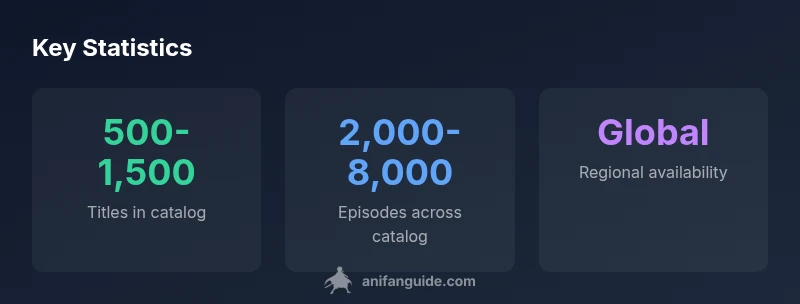
| Catalog Metric | Approximate Range | Notes |
|---|---|---|
| Titles in catalog (anime) | 500-1,500 titles | Estimates vary; dynamic catalog |
| Total episodes | 2,000-8,000 episodes | Aggregate across titles, varies with releases |
| Regional availability | Global with regional licensing differences | Content licensing affects access by country |
Frequently Asked Questions
Does Crunchyroll publish an official count of its anime titles?
No. Crunchyroll does not publish a single official total for its anime catalog; counts vary by region and licensing. Users should rely on filters and regional listings to understand current access.
Crunchyroll does not publish an official total; counts change with regional licensing.
What is included in the 'animes' count on Crunchyroll?
The typical metric counts title-level entries for animated series and films. Live-action titles are not included in the anime tally. Epics like movies within a franchise may be counted as separate titles depending on licensing.
It usually counts animated series and films, not live-action titles.
How often does Crunchyroll add new titles?
Additions occur in waves tied to licensing calendars, simulcast windows, and regional agreements. There is no fixed schedule, and updates can vary by quarter and region.
New titles come in waves; licensing calendars drive additions.
How can I estimate the catalog size today?
Use Crunchyroll’s search and filters, cross-check with reputable lists, and track changes over time. No single source guarantees a complete count due to regional access.
Look across filters and third-party lists to estimate what’s available in your region.
Do regional differences affect the number of animes I can access?
Yes. Licensing deals determine which titles appear in each country. A title may be available in one region but not in another.
Region matters; some shows aren’t available everywhere.
“Crunchyroll’s catalog is a living library shaped by licensing and regional rights; there isn’t a single fixed tally. Viewers should expect fluctuating counts and use filters to navigate the library.”
Main Points
- Understand that official counts are not published
- Catalog size is a moving target, not a fixed number
- Titles vs. episodes are different metrics—both matter
- Regional licensing drives access more than global totals
- Use filters and trackers to gauge current availability for your region