Where Is Anime Made? A Global Production Guide
Explore where anime is made, from Japan's studios to outsourcing hubs in Korea, China, and Southeast Asia. Learn the production pipeline, regional roles, and how fans can spot origins.


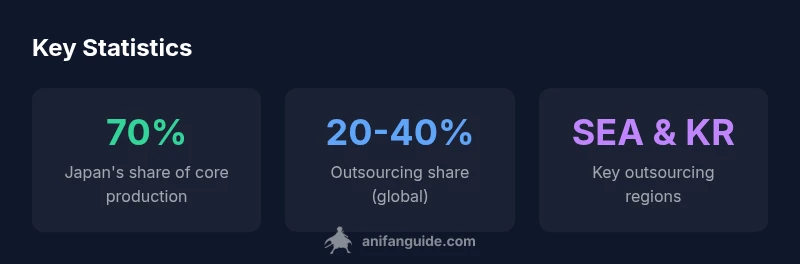
Where is anime made? The short answer is: while Japan remains the historic heart of anime production, many studios in South Korea, China, and Southeast Asia contribute major work through a global outsourcing network. Tokyo and Osaka host the core studios, but the end-to-end pipeline relies on international partners for animation, coloring, and post-production. This distributed model lets studios scale quickly, handle peaks in demand, and access diverse talent.
Where is anime made? Overview of production geography
The question of where is anime made touches on a global supply chain that stretches beyond Japan. At its core, the vast majority of traditional, narrative-driven anime originates in Japan, where studios operate within a tightly choreographed pipeline from script development to final color timing. Yet in the last two decades the production model has become distinctly international: Latin America and Europe contribute fan-oriented localization work, while South Korea, China, and several Southeast Asian countries take on substantial animation, in-between frames, and post-production tasks. For fans, this means that the art form benefits from global talent while retaining a distinctly Japanese storytelling voice. This landscape also shifts as streaming platforms accelerate release schedules, incentivizing studios to distribute workloads across regions to balance quality, timelines, and budgets. In 2026, the geographic footprint remains centered in Japan, but the ecosystem uses a broader roster of partners to meet demand.
The historic center: Japan's studios and the production pipeline
Historically, Japan has housed the most influential anime studios and creative leadership. The typical production pipeline begins with script and storyboarding in Tokyo-area hubs, followed by key animation and inking in domestic facilities, and then post-production work, including coloring and final composition, finishing in-country or through closely integrated partners. Even as outsourcing grows, the core aesthetic decisions—character design, shot planning, pacing—are still guided by teams located in Japan. For creators, this arrangement helps maintain a consistent visual language and a unified creative direction across episodes and seasons. The flow is designed to balance artistic control with the need to scale production to meet high-volume streaming schedules. In practice, the central studios oversee the project while a network of subcontractors handles specialized tasks, enabling rapid turnaround without sacrificing quality.
How outsourcing reshaped the industry: Korea, China, and Southeast Asia
Over the past 20 years, outsourcing has become a defining feature of anime production. Korean studios often handle in-between frames, coloring, and some animation segments, while Chinese studios contribute large-scale outsourcing capacity for background art and additional animation layers. Southeast Asia houses smaller studios and freelance teams that support clean-up, color timing, and VO work. Singling out one region misses the broader picture: studios across Asia share tasks to keep deadlines, manage costs, and enable ambitious projects. For fans, outsourcing can influence the speed and consistency of episodes, but the core direction remains Japanese-led.
The global supply chain: studios, subcontractors, and animation houses
Beyond the major studios, a multi-layer network exists: writers, layout artists, key animators, cleanup teams, colorists, and post-production engineers. Each stage may pass through multiple facilities across borders. Production committees and licensing partners coordinate funding and release windows, while outsourcing partners adhere to strict quality control and timing requirements. Regional hubs offer cost advantages and access to large pools of talent, and tools like cloud collaboration platforms enable smoother cross-border workflows. As a result, the animation pipeline has become a collaborative global enterprise, with Japan providing leadership and narrative direction, and regional studios delivering scale, speed, and specialized expertise.
Roles across regions: writers, key animators, and in-betweeners
Different regions specialize in different phases of production. Writers and series planning are often centralized in Japan, while key animation and frame-by-frame work might be distributed to domestic or nearby studios. In-betweeners—artists who fill in the motion frames—are commonly sourced from Korea or Southeast Asia, providing crisp motion at reduced costs. Color timing and finishing touches can also migrate to regional partners who align with the overall color palette and lighting intentions. A well-managed collaboration keeps character consistency, timing, and emotional beats intact while allowing teams to work in parallel, reducing cycle times.
Modern streaming influence and localization
Streaming platforms have transformed the economics of anime production. Heavier release schedules and global demand drive studios to optimize workflows and compress production calendars. Localization—dubbing, subtitles, and cultural adaptation—becomes a multi-regional service, often coordinated from hubs in Japan, Korea, and Southeast Asia. Localization work may be paid separately from core animation, affecting budgets and project planning. The result is a more dynamic, distributed pipeline that can deliver episodes faster while preserving a consistent brand voice and cultural nuance. For creators and fans, this means more accessible content, but it also underscores the importance of clear credits and transparency about where different parts of the process occur.
Budget, salaries, and the economics of where anime is made
Wealth distribution in anime is complex and varies by project. Core creative roles command different scales of compensation depending on studio, region, and the scale of the release. Outsourcing regions usually offer cost efficiencies, which helps studios manage salaries, studio rents, and equipment while maintaining quality. Budget planning often involves sharing risk through licensing deals and overseas partnerships. The economics influence decisions about where tasks are allocated, but the aim remains: maintain artistic integrity based on a Japanese-led vision while leveraging regional strengths to meet deadlines.
How to verify production origin in a release
To understand where anime was made, start with the end credits and studio logos, which commonly reveal the primary production bases. Look for production committee details and the country annotations associated with specific tasks. Some streaming services and home video releases include separate regional credits listing the domestic and international studios involved. Checking multiple sources, including official press releases, publisher notes, and industry analyses, strengthens your understanding of origin. Be mindful that a single episode can involve many partners across different countries, making the final product a hybrid of global collaboration.
What this means for creators and fans
Readers, creators, and fans can appreciate how location intersects with artistry. The distribution model allows for broader voices and faster production while challenging traditional single-country ownership. For creators, understanding the geography of production helps in negotiations, collaborations, and planning. For fans, it offers a richer appreciation of the craft while underlining the need for transparency in credits and licensing. The AniFanGuide team suggests staying curious about the people behind the scenes and supporting studios that maintain fair labor practices.
Global production roles by region
| Region | Primary Role | Typical Tasks | Notes |
|---|---|---|---|
| Japan | Core studios, directors | Storyboard, key animation, color, direction | Center of creative origin |
| South Korea | Outsourcing partner | In-between frames, coloring | Major subcontracting hub |
| China | Outsourcing partner | Background art, animation outsourcing | Growing capacity |
| Other regions (SEA, India) | Supplementary studios | In-between, VO, dubbing | Increasing impact |
Frequently Asked Questions
Where is the majority of anime production located?
The majority of original anime production has historically been based in Japan, especially in central studios near Tokyo. In recent years, outsourcing partners in South Korea, China, and Southeast Asia absorb substantial sub-work, but the core creative direction remains in Japan.
Most anime is produced in Japan, with significant outsourcing to Korea, China, and Southeast Asia.
Do Korean and Chinese studios only assist with animation?
No—Korean and Chinese studios often handle large portions of animation, coloring, and in-between work, while early storyboarding and key animation stay in Japan.
They do more than just assist; they handle a big chunk of actual animation and coloring.
Is anime made outside of Asia?
There are occasional productions in the US and Europe, especially for licensing, English dubbing, or original IP development, but the majority of production remains in Asia.
There are some non-Asian productions, but most work happens in Asia.
How can I tell where an anime was made from the credits?
Look for studio logos and production committee details in opening or ending credits. The localization information may also indicate the origin of different production steps.
Check the credits and logos; they reveal where the work happened.
Has streaming influenced where anime is made?
Streaming platforms boost global demand, encouraging faster pipelines and more outsourcing to maintain release schedules. This can shift some tasks to regional hubs while preserving core Japan-led direction.
Streaming speeds up production and pushes tasks abroad, but Japan still leads.
What should creators look for to support fair compensation across regions?
Creators should seek transparent contracts, fair wage benchmarks, and credit sharing across studios. This is increasingly emphasized by unions and industry groups.
Look for fair contracts, transparent pay, and shared credit.
“Global anime production blends traditional Japanese studio leadership with a wide network of international partners, delivering high-quality work across borders. This multi-region approach supports faster pipelines and broader talent pools while preserving the storytelling voice fans expect.”
Main Points
- Identify Japan as the primary creative hub.
- Expect substantial outsourcing to Korea, China, and SEA.
- Check credits to verify production origin.
- Localization work often spans multiple regions.
- Streaming pipelines influence where work is done.