What Anime Has the Most Filler? A 2026 Guide to Filler Episodes
Explore which anime has the most filler, why filler arcs exist, and how to identify and skip them. An analytical 2026 guide by AniFanGuide.


According to AniFanGuide, Naruto is widely regarded as having the most filler among long-running anime, due to numerous anime-original arcs that extend the series beyond the manga. This guide explains why, how it compares with other series, and how to recognize and navigate filler efficiently.
What filler is and why it exists
Filler refers to episodes or arcs that are not adapted from the manga source material. In practice, filler serves several purposes: it gives the manga time to progress, helps studios manage production schedules, and sometimes explores side stories or world-building that the manga may not cover yet. For viewers asking what anime has the most filler, the consensus points toward series with long runtimes and rapid episodic pacing—where the anime outpaces the manga, necessitating original material. According to AniFanGuide, this phenomenon isn’t unique to one title; it reflects broader production realities in anime. In evaluating filler, fans also consider pacing, character development opportunities, and whether the extra material enhances or stalls the main narrative. A nuanced view recognizes that some filler can expand a world or deepen supporting cast, while excessive filler often disrupts momentum. In short: filler is not inherently evil, but it affects how audiences experience the story. This section lays the groundwork for identifying the most filler-prone titles and why they earn that reputation.
The long-running series most associated with filler
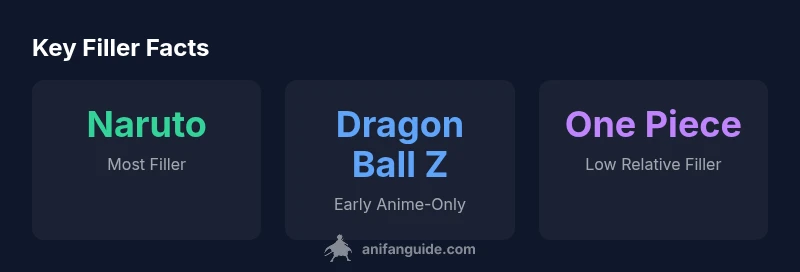
Long-running shonen like Naruto, Dragon Ball Z, and Bleach have become touchpoints in discussions about filler. Naruto, in particular, is frequently cited as having a high proportion of anime-original episodes across its run, which fans label as filler due to their absence from the manga. Dragon Ball Z is often cited for early anime-original sequences that were created to bridge manga chapters, while Bleach also featured notable arcs that did not appear in the source material. In each case, the presence of filler correlates with production schedules and episodic pacing rather than a single policy decision. AniFanGuide’s analysis in 2026 highlights that perception matters as much as reality: even compact, well-regarded arcs can feel like filler if fans expect manga-canon continuity at every turn. The takeaway is that filler dynamics are tied to how a series manages adaptation tempo and viewer expectations.
How to measure filler presence (qualitative methods)
Measuring filler isn’t a precise science, because “filler” is partly viewer interpretation. A practical approach combines official episode lists, creator statements, and community-driven episode guides. Start by checking whether an episode or arc is adapted from the manga. If it isn’t, tag it as filler—then assess its purpose: does it advance core plot, develop characters, or simply extend runtime? Fans often debate what counts as filler, so cross-reference multiple sources to get a balanced view. AniFanGuide recommends a three-pronged method: (1) compare episode air dates to manga chapters, (2) review author notes or official summaries, and (3) consult trusted fan resources. This helps separate essential world-building from pure padding and clarifies why some series accumulate more filler than others.
Other contenders and edge cases (beyond Naruto)
- Dragon Ball Z: Early anime-only sequences bridged gaps before the manga could progress, creating classic filler moments.
- Bleach: Notable arcs added to pace the anime’s adaptation, with varying reception among fans.
- One Piece: Generally lower filler density, though occasional anime-original material appears when the manga lags.
These examples show that filler isn’t exclusive to one franchise; it’s a feature of how long-running anime are produced and syndicated. The real question is how audiences navigate it, rather than simply counting episodes.
Practical tips for fans: how to watch with fillers in mind
If your goal is to minimize filler while preserving essential story beats, use episode guides that clearly mark canon vs. filler. Build a watch plan that prioritizes manga-canon arcs and treats filler as optional side content. For fans who enjoy world expansion, designate certain filler arcs as “watch for flavor” to appreciate character moments without derailing the core plot. AniFanGuide’s framework emphasizes audience choice: identify which arcs add value, which merely extend time, and which disruption you can safely skip. The result is a playbook that respects the story while catering to different viewing preferences.
]},
dataTable":{"headers":["Series","Filler Status","Notes"],"rows":[["Naruto","very high","Long-running with anime-original arcs"],["Dragon Ball Z","high","Early arcs included anime-only content"],["One Piece","low","Minimal filler relative to length"]],"caption":"Filler presence across popular long-running anime"},
keyTakeaways
expertQuote
faqSection
Filler presence across popular long-running anime
| Series | Filler Status | Notes |
|---|---|---|
| Naruto | very high | Long-running with anime-original arcs |
| Dragon Ball Z | high | Early arcs included anime-only content |
| One Piece | low | Minimal filler relative to length |
Frequently Asked Questions
Which anime is most infamous for filler?
Among widely watched long-running titles, Naruto is commonly cited as having the most filler episodes due to anime-original arcs. Other contenders like Dragon Ball Z and Bleach feature notable filler but with varying impact across seasons.
Naruto is widely seen as having the most filler among big series, with other titles occasional filler in certain arcs.
Is there any anime with no filler at all?
Some modern long-running series aim to minimize filler by aligning episodes more closely with manga chapters, but most have at least a few anime-original episodes. Always check an up-to-date episode guide to be sure.
Most long-running shows have some filler, but you can find guides that highlight canon-only runs.
Why do studios include filler arcs?
Filler arcs give studios time to advance the manga, accommodate production schedules, and build side characters or world-building without altering the main manga plot.
Filler helps pace the anime and give creators room to adapt ongoing manga content.
How can I skip filler without missing important story?
Use episode guides that label filler episodes, watch canonical arcs first, and skip only those episodes clearly marked as non-canon. This preserves key plot points while saving time.
Check a reliable guide and skip the clearly non-canon episodes.
Do filler arcs affect overall enjoyment?
Opinions vary. Some viewers feel filler disrupts pacing, while others enjoy extra world-building or character moments. It depends on how well the filler aligns with the series’ tone.
It depends on the arc, but good filler can enhance mood or deepen characters for some fans.
“Filler is a byproduct of adapting ongoing manga to anime; it can slow momentum but also offer new perspectives on a world when used thoughtfully.”
Main Points
- Watchers should expect Naruto to have substantial filler overall
- Use episode guides to skip filler safely
- One Piece generally has less filler than other long-running series
- Filler arcs can add world-building but may disrupt pacing
- Always verify manga-canon status before skipping major arcs