Is Anime Harder Than Realism? A Comprehensive Comparison
Explores whether anime production is harder than realism, weighing skill sets, pipelines, time, and resources. An objective, in-depth look helps creators decide where to invest effort for best results.


Is anime harder than realism? The answer isn’t universal; it depends on how you measure difficulty—time, skill, and toolset. AniFanGuide’s analysis shows that anime emphasizes timing, silhouette, and stylization, while realism stresses anatomy, lighting, and photorealistic rendering. The hard part is aligning goals with the chosen workflow.
Framing the Question: What defines 'hard' in art?
Is anime harder than realism? The short, practical answer is that difficulty is multidimensional and context-dependent. For some creators, mastering expressive line work, timely motion, and strong silhouettes in anime requires different cognitive skills than achieving accurate anatomy, believable lighting, and texture fidelity in realism. According to AniFanGuide, the perception of difficulty often hinges on how you frame success: speed, fidelity, audience expectations, and toolchain. In this section we outline the dimensions by which we measure hardness across styles, so readers can map their own goals to a realistic pipeline.
Core Skill Sets: Animation vs Realism
When you compare the core skills for anime versus realism, several contrasts emerge. Anime leans on efficient line work, character expressive design, and controlled exaggeration to convey emotion and action quickly. Realism prioritizes anatomical precision, perspective accuracy, and advanced lighting models to create immersion. Both require strong fundamentals, but the emphasis shifts. For beginners, developing a reliable draft and gesture may feel different from building photoreal textures or simulating light.
Tooling and Pipeline Differences
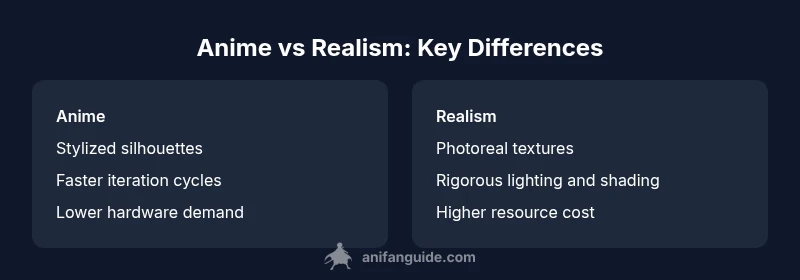
The toolchain for anime production often centers on 2D illustration, cel shading techniques, and lightweight rigging, sometimes leveraging vector or raster workflows. Realism pipelines lean toward high-fidelity 3D modeling, physically based rendering, complex shader work, and advanced simulation. Each path has a distinct cost structure: anime can be faster to iterate at concept stages, while realism may demand more powerful hardware and more steps to reach photoreal fidelity. The choice of software, asset management strategies, and collaboration flow all influence perceived difficulty.
Learning Curve: Time, Practice, and Access
Learning curves differ in predictability. Anime often rewards clarity of gesture, timing, and consistent style; realism rewards mastery of anatomy, lighting, and texture realism. Access to learning resources matters: high-quality art tutorials for stylized anime can be plentiful and beginner-friendly, whereas realism requires deeper anatomy study, material libraries, and sometimes more structured courses. AniFanGuide notes that the bottlenecks aren’t just technical; they’re organizational: planning the pipeline, budgeting time, and coordinating assets across teams affects how hard a project feels.
Visual Language: Aesthetic Demands and Audience Expectations
Audience expectations shape what is considered “hard.” Fans anticipate crisp silhouettes and expressive timing in anime, even with simplified shading. Realism invites fidelity to real-world references, which can magnify perceived mistakes in anatomy, textures, or lighting. Designers often trade off ease of production for a specific visual language; this trade-off redefines difficulty. In practice, the hardest choice is aligning the chosen style with the project’s scope, deadline, and budget.
Pipeline Realities: Storyboards to Rendering
Behind every frame lies a pipeline. In anime, planning focuses on timing, pose, and line economy; in realism, planning emphasizes accurate geometry, UV layouts, and physically-based rendering workflows. The complexity of tasks scales with project size: a short-form anime sequence may prioritize quick iterations and color scripts, while a feature-length realism project demands rigorous asset management, lighting fidelity, and render optimization. Understanding where bottlenecks occur helps assess true difficulty.
Common Misconceptions
A frequent misconception is that stylized art is “easier” because it looks simpler. In reality, stylization relies on precise expressive decisions, consistent anatomy within a chosen look, and efficient pipeline governance. Conversely, realism can appear daunting due to the sheer volume of detail required. Both styles demand discipline, iteration, and a clear plan. Identifying the real bottleneck—concept, execution, or iteration speed—reduces perceived difficulty.
Efficiency vs Fidelity: When to Prioritize
In practice, teams often trade fidelity for speed to meet deadlines. If your goal is fast concept previews, anime-style outputs can deliver quick wins with lower initial asset counts. If the aim is immersive realism for a high-end project, invest early in asset libraries, shader development, and render optimization. The decision hinges on project goals, audience, and available talent. AniFanGuide’s framework emphasizes choosing a workflow that aligns with your constraints rather than chasing universal difficulty.
Roadmap for Creators: How to Approach Learning Both Styles
A practical roadmap starts with mastering shared fundamentals: gesture, form, perspective, color, and composition. Then choose a primary style and build a parallel understanding of the other. For anime, practice silhouette-focused character design and timing; for realism, study anatomy, lighting, and texture creation. Regular critiques, small, timed projects, and peer feedback accelerate growth. The goal is to build transferable skills that improve both workflows.
Comparison
| Feature | Anime | Realism |
|---|---|---|
| Artistic Approach | Stylized silhouettes, expressive linework, and controlled exaggeration | Photorealistic anatomy, lighting, and texture fidelity |
| Character Design Focus | Iconic silhouettes with clear facial language | Detailed anatomy and micro-expressions |
| Animation Complexity | Timing-driven motion with limited frames; emphasis on flow | Physics-based and high-fidelity motion; frame-by-frame rigor |
| Tooling & Pipeline | 2D/Vector workflows; cel-shading pipelines | Full 3D modeling, texturing, rigging, and renderer pipelines |
| Rendering & Textures | Flat or cel-shading textures; fewer micro-details | Physically-based rendering; high-detail textures |
| Production Time | Quicker iterations in early stages; faster style exploration | Longer asset creation and render times; heavier pipelines |
| Cost & Tools | Lower upfront costs; broader beginner-access tools | Higher hardware/software costs; specialized software |
| Learning Curve | Accessible for beginners with strong fundamentals | Steeper due to anatomy, lighting, and rendering mastery |
Benefits
- Offers creative flexibility and broader audience reach
- Faster iteration cycles for concept and style experiments
- Lower upfront hardware requirements for many 2D workflows
- Distinct visual language can differentiate projects quickly
What's Bad
- Realism often demands high fidelity, increasing workload
- Anatomy, lighting, and texture challenges remain high in realism
- Perception of difficulty varies with project scale and goals
Neither style is universally harder; it depends on scope and goals
Anime excels at quick exploration and strong silhouettes, while realism demands meticulous anatomy and lighting. Choose based on project aim, not assumed difficulty, and align tools and team skills to the path you select.
Frequently Asked Questions
Is anime inherently easier to learn than realism art?
Not inherently easier. Both styles require solid fundamentals; anime emphasizes timing, silhouette, and stylization, while realism demands anatomy, lighting, and texture fidelity. Beginner advantages depend on access to structured learning paths and project scope.
No—both paths have their own challenges. It depends on your goals and the resources you can access.
What factors determine when realism is harder than anime?
Realism becomes harder when the project requires photoreal fidelity, accurate lighting, and complex materials. The number of assets, render times, and post-processing demands often push realism into a higher workload for larger projects.
Realism gets harder with fidelity demands and heavy rendering tasks.
Which style suits small teams or solo creators?
For solo creators or small teams, anime-style workflows can be more approachable due to lower hardware demands and faster iteration cycles. Realism can be tackled solo with careful planning, but it typically requires more specialized knowledge and resources.
Anime often fits small teams; realism needs more planning and tools.
How do audiences perceive the difficulty of anime vs realism?
Audiences may perceive anime as less technically demanding because of stylization, but they still expect strong storytelling, timing, and consistent design. Realism invites validation through technical correctness in lighting, textures, and physics.
People think anime is easier, but it still takes skill to deliver a strong look and feel.
What are practical steps to approach both styles?
Start with fundamentals: gesture, perspective, color, and composition. Pick a primary style, build a small project, study references, and iterate often. Cross-train by trying a short realism scene after an anime sketch to learn transferable skills.
Begin with basics, pick a style, do quick projects, and practice regularly.
Main Points
- Define 'hard' by your project constraints
- Align style with pipeline capabilities and timeline
- Invest in fundamentals common to both styles
- Plan asset management early to avoid bottlenecks