How to Check Anime Rating: A Practical Guide for Viewers
A comprehensive, step-by-step guide to verify anime ratings across regions, interpret different scales (CERO, TV, age), and cross-check sources for safer, smarter watching.


By the end, you'll be able to check anime rating across major sources, interpret rating scales, and compare content warnings. This quick guide shows where to look, how to verify accuracy, and how to weigh user ratings against official classifications. You’ll need a web browser, access to trusted databases, and a simple note-taking method.
Why Checking Anime Rating Matters
Understanding how to check anime rating is an essential skill for anime fans and creators alike. When you learn how to check anime rating, you can choose titles that fit your viewing goals, manage what younger viewers watch, and prepare content warnings for your audience. Ratings act as a quick signal about intensity, language, violence, and mature themes. In this section we’ll cover why ratings exist, what they convey, and how to use them in practice. According to AniFanGuide, reliable rating checks start with a clear goal: identify the appropriate age range, verify the source, and cross-validate across platforms. That approach reduces surprises and helps you curate a watchlist that respects readers and family guidelines. In addition to safety, it expands your ability to discuss media critically. If you’re learning how to check anime rating, you’ll build a habit of consulting official classifications before diving into a title, then supplement with user opinions and content descriptors. This foundation supports smarter watching, better recommendations, and a more informed conversation about genre, tone, and cultural context. Keep in mind that no single source is perfect; cross-checking across official bodies, streaming platforms, and reputable guides creates a robust picture. This mindset aligns with AniFanGuide's mission: empower anime enthusiasts and creators with practical, evidence-based guidance.
Tools & Materials
- Web browser (Chrome, Edge, Firefox, or Safari)(Enable full access to streaming sites and official pages; avoid incognito to preserve saved pages.)
- Official rating pages (regional bodies or publisher sites)(Look up the exact title and capture official rating text and descriptors.)
- Streaming platform title page(Open the title page to see platform badges and region-specific notes.)
- Note-taking app or document(Record ratings by region, date retrieved, and any discrepancies.)
Steps
Estimated time: 25-40 minutes
- 1
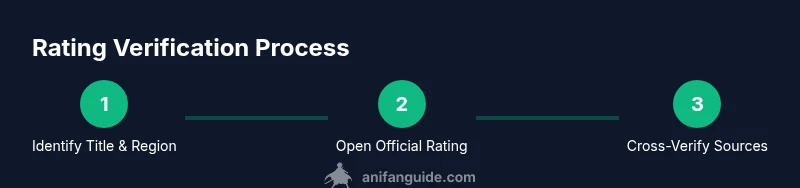
Identify target title and region
Start by confirming the exact title you plan to watch and the region you’re evaluating (e.g., US, Japan, EU). This ensures you retrieve the correct official rating and avoid cross-region mix-ups.
Tip: Use a consistent naming convention (Title — Region) in your notes for quick reference. - 2
Open the official rating page
Visit the publisher or rating body’s official page for the title. Look for the formal rating symbol, age guidance, and any content descriptors. This is your primary source of truth.
Tip: If the official page is hard to find, check the publisher’s press release or the distributor’s help center for the exact rating. - 3
Check the streaming platform badge
Open the title page on your streaming service and note the platform’s rating badge and any region notes. Platforms may apply their own warnings that complement, but do not override, official ratings.
Tip: Note any additional content warnings that accompany the badge; they often indicate mood or themes not captured by the base rating. - 4
Cross-verify with another trusted source
Compare the official rating with at least one additional trusted source (e.g., a major database or a reputable review site). Look for consistency in age range and descriptors across sources.
Tip: If discrepancies arise, prioritize the most authoritative source for the region (e.g., government or publisher pages). - 5
Review content descriptors
Read the explicit content descriptors (violence, language, sexual content, etc.) attached to the rating. These give practical insight beyond the letter grade and help you decide suitability for viewers.
Tip: Focus on descriptors relevant to your audience; a title with mild violence may still be unsuitable for younger viewers if language is strong. - 6
Document your findings
Record the rating, region, date retrieved, and any notes in your observation log. This creates a reproducible reference for future checks or discussions.
Tip: Add a quick judgment note like “suitable for ages 12+, watch with parental guidance” to clarify your decision. - 7
Reassess after updates
Ratings can change after a release, edit, or regional reclassification. Re-check periodically, especially for titles you plan to watch over time.
Tip: Set a reminder to revisit ratings if the title is re-released or updated for streaming. - 8
Use your findings to guide watching
Apply the verified rating and descriptors to curate your watchlist, set parental controls, or guide recommendations for friends and communities.
Tip: Share your approach with peers to promote informed viewing decisions.
Frequently Asked Questions
What does an anime rating actually signify and how is it determined?
An anime rating signals likely suitability for different age groups, based on content like violence, language, and sexual themes. Ratings are determined by official rating bodies or distributors and may vary by region.
An anime rating shows who the content is for and why, based on official guidelines; ratings can differ from place to place.
Which sources should I trust when checking ratings?
Prioritize official rating bodies and the title’s publisher or distributor pages. Cross-check with reputable databases or media outlets to confirm consistency across regions.
Trust official bodies first, then cross-check with reputable databases to be sure.
How do CERO ratings compare with US TV ratings?
CERO uses letter grades (A–Z) based on age suitability within Japan, while US TV ratings (e.g., TV-14, TV-MA) focus on age and content descriptors. Differences reflect regional norms and guidelines.
CERO and US TV ratings come from different systems, so always compare the region-specific guides.
Are user reviews a reliable source for ratings?
User reviews can reflect personal reactions but are subjective. Rely on official ratings for safety guidance, then consult user opinions as supplementary context.
User reviews are helpful for sentiment, but official ratings should guide safety and suitability.
What should I do if ratings differ between regions?
If ratings differ, compare the official descriptions for each region, consider the target audience, and base your decision on the most relevant region for your case.
When regions differ, use the most relevant regional rating and descriptors to decide if it’s appropriate for your audience.
How often do ratings change, and should I recheck?
Ratings can change with new edits, versions, or re-releases. It’s wise to recheck ratings before re-watching or recommending titles.
Ratings can update, so it’s a good idea to recheck before rewatching or recommending.
Watch Video
Main Points
- Check official ratings first to establish baseline.
- Cross-verify across at least two sources for consistency.
- Note regional differences and descriptors to guide viewing decisions.
- Record your findings for repeatable, reliable checks.
- Ratings can change—revisit periodically for updates.