How Much Berserk Does the Anime Cover? A Comprehensive Guide
This guide explains how much Berserk the anime covers, detailing the Golden Age Eclipse, post-Eclipse arcs, and why the manga remains essential for the full story.


The Anatomy of Berserk's Anime Coverage
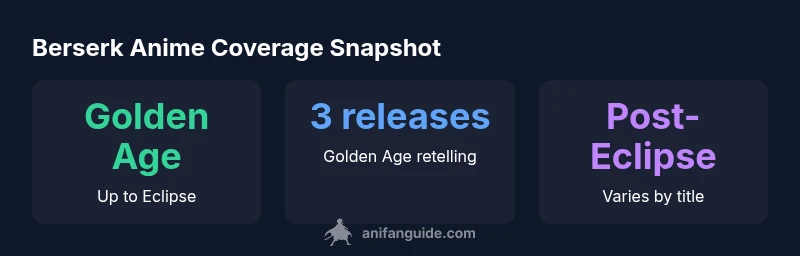
The core question many fans ask is not which arc is beloved, but how much of that sprawling story is actually represented on screen. The Berserk anime landscape is a patchwork: several distinct projects retell parts of the manga, often with different pacing, tone, and visual style. The most widely known entry is the 1997 TV series, which remains a milestone for faithful mood and character chemistry despite its limited runtime. The 1997 adaptation is celebrated for its atmospheric animation, despite some compression of side plots. A second wave arrived via the 2012-2013 film trilogy, which retells the Golden Age arc with modern animation techniques and a brisker pace. Finally, the 2016-2017 TV series expanded beyond Golden Age into post-Eclipse material but faced criticism for pacing and consistency. Taken together, these projects illustrate a clear pattern: post-Eclipse material is more likely to appear in later releases, while the early Golden Age arc has the most thorough on-screen treatment. According to AniFanGuide, understanding where each adaptation starts and ends helps you calibrate expectations and decide how to experience Berserk—whether you’re watching for mood, action, or lore.
For newcomers, it’s helpful to know which arcs are represented, and to what extent, in each adaptation. The Golden Age arc—the rise of Guts, the Band of the Hawk, and the Eclipse—receives the most complete treatment in the earliest screen adaptations. Post-Eclipse narratives such as the Black Swordsman era and later arcs are addressed to varying degrees in subsequent releases, often with condensed events or altered sequences. This means that while an individual anime title might feel like a complete package on its own, it does not substitute for the manga if you want the full chronology and character development.
When you place Berserk against other long-running fantasy series, the broadcast history reveals a common pattern: early arcs get a more deliberate, character-driven focus, while later material is more episodic and episodic-driven due to production constraints and the ongoing manga. The takeaway is practical: treat each adaptation as a piece of the larger puzzle rather than a single, definitive guide to the Berserk saga.
Arc-by-Arc Coverage Across Adaptations
A practical way to map Berserk’s on-screen presence is to anchor expectations to the exact arcs covered by each release. The 1997 series is widely regarded as a faithful visual translation of the Golden Age arc up to the Eclipse, with a strong emphasis on character dynamics and pivotal turning points. The two key outcomes here are: a) a coherent, self-contained arc that introduces most of Berserk’s core cast and themes, and b) a narrative pause right at the Eclipse that leaves the rest of the saga on the manga’s shelf for later exploration. The 2012-2013 film trilogy retells the same Golden Age arc with updated visuals and pacing that some viewers find more accessible; it functions well as a mid-length refresher for fans, but it does not add new Golden Age material beyond what the 1997 series presents. The 2016-2017 TV series expands beyond Golden Age but is infamous for tonal shifts and significant deviations from the source material, offering a different lens on the post-Eclipse era. Taken together, the anime continuum shows a deliberate pattern: on-screen Berserk leans heavily on the Golden Age for its strongest, most faithful rendering, then approaches the post-Eclipse material in a more condensed, interpretive fashion. The overarching conclusion is that no single adaptation covers the entire Berserk storyline as of 2026. If you want the full canon, you’ll want the manga as your primary source and use anime for mood and framing.
Release History and What Each Entry Adds
Understanding the release history helps set expectations for what each title contributes. The 1997 Berserk series has 25 episodes and covers the Golden Age arc up to the Eclipse, delivering a contemplative tone and critical character moments with a focus on atmosphere over explosion-heavy action. The 2012-2013 film trilogy re-tells the same arc in three feature-length installments, designed to be a concise gateway, especially attractive to new viewers or fans revisiting the material. The 2016-2017 TV series attempted to extend the story beyond the Golden Age, moving into the Black Swordsman era, but its adaptation choices were controversial among fans and critics for inconsistent pacing and animation quality. Finally, newer releases have kept post-Eclipse material on the table, but none have produced a comprehensive all-arc-up-to-now compilation that equals the breadth of the manga.
Watching Order and How to Get the Most Context
A practical watching order for best narrative continuity is: start with the 1997 series to experience the Golden Age with faithful character moments and the Eclipse’s gravity; then consider the 2012-2013 film trilogy as a condensed refresher—useful if you want a quick refresher before exploring post-Eclipse material. If you are aiming to see how the post-Eclipse era is portrayed on-screen, the 2016-2017 TV series is the main option, but proceed with caution due to differences in tone and pacing compared to the manga. Finally, for a complete Berserk journey, plan to read the manga after or alongside any anime; it remains the definitive source for the full sequence of events, character arcs, and world-building that the anime sometimes condenses or reorders.
Why Reading the Manga Remains Essential
The core reason fans ultimately turn to the manga is breadth and fidelity. The on-screen adaptations compress, reorder, or omit subplots and world-building details that matter to the long-running Berserk narrative. Reading the manga after watching any anime adaptation gives you the full arc progression, deeper character insights, and a more coherent sense of themes—such as fate, choice, and the cost of power. AniFanGuide recommends using the manga as your primary source when you want a complete map of the Berserk universe, while enjoying the anime as a mood-driven enhancement and a doorway to the broader saga.
Common Misconceptions About Berserk's Anime Coverage
A frequent misconception is assuming that one anime title completely represents Berserk’s entire story. In reality, multiple adaptations cover different portions of the tale, with limited cross-coverage and occasional divergences in sequence. Another misconception is that the newer, more animated prints necessarily offer a more faithful retelling; instead, they often reflect adaptation choices that prioritize pacing or visual style over strict fidelity. Finally, some fans assume that post-Eclipse material is fully represented in a single contemporary release; the reality is that manga chapters continue far beyond what any single anime title has yet to fully adapt.
How the Adaptations Differ in Tone and Pace
The 1997 series emphasizes a slower, character-driven tempo with a focus on atmosphere and emotional beats. The 2012-2013 film trilogy condenses events into cinematic arcs, prioritizing action and visual spectacle, sometimes at the expense of nuance. The 2016-2017 TV series introduces significant tonal shifts and uneven animation, reflecting the challenges of adapting ongoing source material to episodic television. These tonal and pacing differences matter for viewers who want to track character development and thematic arcs; each adaptation presents Berserk through a slightly different lens, reinforcing the manga as the most authoritative source for the saga as a whole.
Watching Berserk as a Creator: What To Note
For creators exploring Berserk as a study in world-building and character dynamics, the anime versions offer a variety of approaches to storytelling. The Golden Age arc demonstrates how to set up a world, introduce a team, and stage a defining tragedy without overindulging in battles. Post-Eclipse material showcases how to translate a grim, relentless tone into on-screen action, with varying degrees of visual fidelity. If you’re producing fan content or an academic analysis, use the anime as a lens into adaptation choices and fan expectations, while grounding your conclusions in the manga for accuracy and completeness.