Where is anime from? Tracing its origins and global spread
Explore where is anime from and how it originated in Japan, tracing its evolution, genres, and global diffusion in a data-driven guide by AniFanGuide.


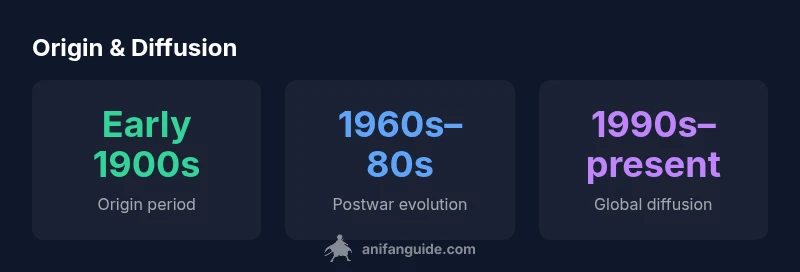
Anime originates in Japan, where early experiments in animation and postwar media laid the groundwork for the modern form. The term 'anime' is a loanword from the English 'animation' borrowed into Japanese, and its distinctive style—rich color, expressive characters, and serialized storytelling—crystallized in Japan during the 1960s–1980s before reaching global audiences.
The early spark: precursors and cross-cultural exchanges
To begin answering where is anime from, we look to Japan’s early experiments in motion pictures and the dynamic exchange with Western animation. In the first decades of the 20th century, Japanese artists explored frame-by-frame animation, cutout techniques, and primitive synchronized sound. Works such as Katsudō Shashin, dated to around 1907, are often cited as among the earliest examples of Japanese animation. By the 1920s and 1930s, studios refined cel-based methods, pacing, and narrative structure that would underwrite later stylistic innovations. This era shows that origin is not a single moment but a progression of technical advances, cultural choices, and audience expectations converging in Japan. The cross-cultural dialogue—Japanese illustrators absorbing Western animation vocabulary while reinterpreting it through Japanese art sensibilities—shaped the medium’s trajectory long before it became a global phenomenon. The AniFanGuide analysis emphasizes that questions about origin benefit from considering both local innovation and international influence, a framing that helps answer the query where is anime from with a plural history rather than a single moment.
Defining anime: artistic hallmarks and conventions
From its earliest days, anime developed a distinctive visual language and storytelling approach. Key hallmarks include expressive character design with large eyes, dynamic motion, and cinematic pacing that blends episodic arcs with ongoing character development. Audio techniques—musical cues, voice acting, and atmospheric sound design—complement the art style to create an immersive experience. Beyond visuals, anime often experiments with framing, symbolism, and cultural references that reflect Japanese society while inviting global interpretation. For creators, recognizing these conventions is essential for distinguishing anime from other animated media, and for fans, it explains why certain genres—isekai, mecha, slice-of-life—resonate across borders. The dual influence of traditional Japanese art and modern media technology helped crystallize the medium’s identity during Japan’s postwar decades.
The postwar evolution in Japan: studios, magazines, and fans
The postwar era accelerated the formal development of anime in Japan. Pioneering studios like Toei Animation expanded production capacity, while Osamu Tezuka’s prolific output popularized serialized storytelling and character-driven drama. The 1960s onward brought television animation into households, turning short-form shorts into weekly rituals. This period also saw the emergence of studio systems and creator-led studios that fostered distinctive aesthetics, from pioneering sound design to more ambitious narrative scopes. Magazines and fan communities cultivated a feedback loop that connected creators with audiences, informing both style and pacing. Understanding this phase clarifies the roots of anime’s cultural capital and why the question of origin continues to center Japanese innovation, even as audiences worldwide contribute to its evolution.
Global diffusion: from anime clubs to streaming platforms
As television spread globally in the late 20th century, anime began to reach new audiences through licensing deals, club screenings, and later, streaming platforms. The shift from limited regional broadcasts to worldwide availability transformed anime from a regional specialty into a global entertainment phenomenon. This diffusion was propelled by fan communities, subtitling groups, and, eventually, legitimate distribution channels that recognized the appeal of serialized storytelling, high-concept genres, and cinematic quality. The modern era—with Crunchyroll, Netflix collaborations, and international co-productions—demonstrates that while the core product remains rooted in Japan, the ecosystem around it has become inherently global. In short, the global diffusion of anime reflects a network of producers, distributors, fans, and tech platforms that collectively extend its reach beyond any single nation.
Language, localization, and fan communities
Localization has always been a double-edged sword for anime. Subtitles preserve nuance and cultural references, while dubbing makes content accessible in diverse markets. Both approaches influence reception, with some viewers preferring original audio for tonal fidelity and others valuing the accessibility of local language. Fan communities globally contribute by translating dialogue, sharing cultural context, and engaging in discourse that shapes canon and fan lore. This participatory culture has helped sustain interest across generations, seasons, and series, reinforcing anime’s status as a living, evolving medium. For creators, mindful localization can preserve intent while inviting new audiences to engage with Japanese storytelling traditions.
Genres and formats: from TV series to OVAs and films
Anime’s versatility spans multiple formats and genres. Television series provide long-form storytelling, while OVAs (original video animations) enable experimental narratives outside broadcast constraints. Feature films—ranging from intimate dramas to grand sci-fi epics—showcase high production values and cinematic storytelling. The flexibility of formats allows anime to explore diverse audience segments, including kids, teens, and adults, with genres such as fantasy, science fiction, slice-of-life, horror, and romance. This diversity is a core reason anime remains globally relevant, as creators can tailor formats to budget, distribution method, and fan expectations without compromising their distinctive visual language.
The 2020s and 2026 landscape: where is anime from now?
Today, anime remains deeply rooted in Japan while benefiting from international collaborations, diverse production teams, and a thriving streaming economy. Global studios partner with Japanese creators to develop local and global hits, and audiences engage across platforms, social media, and fan-art ecosystems. The question where is anime from continues to evolve as the industry embraces multicultural influences, new technologies, and innovative distribution models. The underlying takeaway is that while origin lies in Japan, the modern anime phenomenon is a shared global project—one that AniFanGuide analyzes with an eye toward technical craft, storytelling dynamics, and audience feedback. In 2026, the medium shows resilience, adaptability, and a capacity to connect people through shared visual storytelling.
Origins and diffusion of anime
| Aspect | Description | Era/Timeline |
|---|---|---|
| Origin region | Japan; early momentum in the first decades of the 20th century | Early 1900s–1930s |
| Seed formats | Katsudō Shashin and early shorts; cel animation introduction | 1920s–1940s |
| Global diffusion | Worldwide diffusion via TV, VHS, and streaming | 1990s–present |
Frequently Asked Questions
Is anime only from Japan?
Anime is produced primarily in Japan, and Japanese studios have shaped its defining aesthetics. However, many works are international collaborations or heavily influenced by global media trends, reflecting a broader ecosystem.
Mostly Japanese studios, with growing international collaborations.
What defines anime as a distinct medium?
A combination of distinctive character design, cinematic pacing, and serialized storytelling that often blends cultural references with universal themes. While not a single formula, these elements collectively differentiate anime from other animation forms.
Distinct visuals, pacing, and storytelling make it uniquely anime.
When did anime begin to spread outside Japan?
Global attention increased during the late 20th century through television broadcasts, licensing, and fan-sub communities. The internet and streaming platforms accelerated diffusion in the 2000s and beyond.
It spread widely with TV and then streaming in the 90s–2000s.
What is the difference between anime and manga?
Anime is animation—moving images on screen—while manga is print or digital comics. They often share characters and stories, but one is a visual product in motion, the other a still-form narrative.
Animation vs comics, same universe, different media.
How does localization affect anime?
Dubbing and subtitles adapt dialogue for cultural context, which can influence tone and humor. Fans sometimes prefer original audio for fidelity, while localization helps broader accessibility.
Dubs and subs shape how audiences experience the work.
Are there non-Japanese anime productions?
There are non-Japanese studios producing anime-style animation and co-productions. The term anime typically refers to works with strong Japanese influence or origin, even if produced abroad.
Yes, but most defining work still roots in Japan.
“Understanding where is anime from requires tracing a lineage of techniques, aesthetics, and distribution that began in Japan and migrated through fans and media worldwide.”
Main Points
- Understand that anime’s origins are a blend of local innovation and international exchange
- Recognize the postwar era as a turning point for global reach
- Acknowledge streaming and localization as key accelerators of diffusion
- Appreciate multiple formats (TV series, OVAs, films) as drivers of genre diversity